

Quick Answer: Gauge is the thickness of the jewellery's post, and the number runs backwards: 20g is 0.8mm, 18g is 1.0mm, 16g is 1.2mm and 14g is 1.6mm — the lower the number, the thicker the bar. Standard earrings are 20g; most lobe and nostril piercings take 20g or 18g; cartilage, septum and lip piercings are usually 16g; navels are 14g. The fitting rule is one-directional: jewellery thinner than your piercing goes in but sits loose, and the channel can slowly tighten around it; jewellery thicker than your piercing does not go in and is never forced — sizing up is stretching, and stretching is a piercer's job.
Informational only, not medical advice. If a piercing is hot, swollen, weeping or increasingly painful, see your piercer or GP.
Gauge is the measurement everyone meets last and needs first. Diameter and length are visible; gauge is the near-invisible millimetre of thickness that decides whether a piece of jewellery goes into your piercing at all. Order the wrong diameter and a ring looks off; order the wrong gauge and it either rattles or will not pass.
The system is old wire-gauge convention, which is why it runs backwards and why this guide translates everything into millimetres. Ten minutes here saves every future jewellery order.
What do 16g, 18g and 20g actually mean?
They are post thicknesses: 16g is a 1.2mm bar, 18g is 1.0mm, 20g is 0.8mm — and the lower number is always the thicker bar. The "g" is gauge, borrowed from wire-making, where the number counts how many times the wire was drawn thinner.
| Gauge | Millimetres | Typically worn in |
|---|---|---|
| 22g | 0.6mm | The thinnest nose studs |
| 20g | 0.8mm | Standard earrings, dainty nose studs |
| 18g | 1.0mm | Lobes, nostrils, some helixes |
| 16g | 1.2mm | Cartilage, septum, lip, tragus, rook, daith, conch, eyebrow |
| 14g | 1.6mm | Navel, industrial, tongue, some septums |
Two habits make gauge painless. Think in millimetres, since 1.2mm says what 16g only implies. And remember the direction: going "up a gauge" in thickness means going down in number — from 18g to 16g is up in size.
Gauge, diameter and length are three separate measurements, and a full walkthrough of all three lives in the body jewellery size chart.
What gauge is my piercing?
Whatever it was pierced at — most UK studios pierce lobes at 18g or 20g, nostrils at 18g, cartilage, septum and lip at 16g, and navels at 14g. The table is the convention; your piercer's word is the fact.
| Piercing | Usual gauge | Notes |
|---|---|---|
| Earlobe (studio) | 18g / 1.0mm | Gun-pierced lobes are usually 20g |
| Nostril | 18g, sometimes 20g | 22g exists for the daintiest studs |
| Helix, flat | 16g, sometimes 18g | Studios vary; check yours |
| Tragus, rook, daith, conch | 16g / 1.2mm | The cartilage standard |
| Septum | 16g, sometimes 14g | Septum sizing guide |
| Lip, Monroe, medusa | 16g / 1.2mm | Flat-back labrets |
| Eyebrow | 16g / 1.2mm | Curved barbells |
| Navel | 14g / 1.6mm | Thicker for strength in a mobile spot |
| Industrial | 14g / 1.6mm | One long straight barbell |
If you were pierced in the UK at a studio and never asked, 16g is the safest cartilage guess and 18g the safest lobe guess — but "ask the studio" beats guessing, and most will tell you from their records in one message.
Can I wear 18g jewellery in a 16g piercing?
Yes — a thinner bar always fits through a thicker channel — but it sits loose, moves more, and over months the channel can quietly tighten down around it. Thinner works; it just carries two trade-offs worth knowing.
The first is movement. A 1.0mm bar in a 1.2mm channel has room to slide and tilt, which healed piercings tolerate but healing ones resent — more movement means more irritation. On lobes specifically, thin wire plus heavy or dangly jewellery concentrates weight on less skin, the slow "cheese-wiring" effect that elongates old lobe holes.
| You have | Your piercing is | Result |
|---|---|---|
| Thinner jewellery (18g in a 16g hole) | Thicker channel | Fits, sits loose; channel may shrink around it over months |
| Exact match (16g in a 16g hole) | Same | The comfortable standard — no movement, no surprises |
| Thicker jewellery (16g in an 18g hole) | Thinner channel | Does not fit; never forced — sizing up is piercer-led stretching |
The second is shrinkage. A channel holds the size of what it wears, so a 16g piercing worn at 18g for a year may no longer take 16g jewellery without resistance — and resistance means a piercer with a taper, never a push. Dropping a gauge is easy to do and surprisingly hard to undo, so do it deliberately, not accidentally through whatever was in the drawer.
Can I wear 16g jewellery in an 18g piercing?
No — thicker jewellery does not fit a thinner channel, and forcing it tears the piercing. Going up a size is stretching, a deliberate, gradual process, and the first conversation about it belongs at your piercer's counter.
This is the one-way street at the heart of gauge. A 1.2mm bar meeting a 1.0mm hole has nowhere to go; pushed anyway, it splits healed tissue, and torn channels heal with scar that makes every future piece of jewellery harder to wear. The temptation is strongest with a piece you love in the wrong gauge — and the answer is the same piece in the right gauge, which is exactly why multi-gauge designs exist.
If you genuinely want a thicker gauge — some people size septums or lobes up — piercers stretch in single steps with tapers, letting the channel settle for weeks between steps. Slow is the entire method; anything that hurts, bleeds or resists is the signal to stop.
How do I find out what gauge my jewellery is?
Measure the post with digital calipers, compare it against a piece whose gauge you know, or take it to a piercer — never judge thickness by eye. The differences are 0.2mm steps and eyes are terrible at 0.2mm.
Digital calipers cost a few pounds and settle it instantly: 0.8, 1.0, 1.2 or 1.6mm across the post. The comparison method is free — hold the mystery piece against a labelled one and feel which is thicker — and works better than it sounds because adjacent gauges differ by a visible fraction when side by side. Printable gauge cards with punched holes also exist.
What not to do: assume all your jewellery matches, since drawers accumulate 20g fashion earrings next to 16g cartilage pieces, and the two are not interchangeable. When you buy from a proper body-jewellery range, every listing states the gauge, which is the habit that makes the calipers redundant.
Which jewellery covers more than one gauge?
A design made in every gauge — like a plain hinged clicker sold in 20g, 18g, 16g and 14g — lets you match any piercing exactly instead of making one thickness do every job. This is the clean answer to a drawer full of mismatched holes.
Our plain Hinged Segment Clicker Ring in Silver at £10 is exactly that: the same seamless hinged ring in 20g, 18g, 16g and 14g, with diameters from 6mm to 16mm — so the 0.8mm version dresses a dainty nostril, the 1.2mm one a septum or helix, and the 1.6mm one a stretched lobe or septum, each fitting its channel exactly.

Matching gauge to channel is most of what "comfortable jewellery" means in practice: no rattle, no cheese-wire pressure, no slow shrinkage surprises. Pick the piercing's gauge, then choose diameter for the look — snug or swinging — with the gauge decision already made for you.
Why does gauge matter more for rings than studs?
A stud sits still; a ring moves — and a too-thin ring moves with all its weight on a wire-thin contact line. Gauge mistakes show up fastest on hoops.
A loose 20g hoop in a 16g helix channel swings with every head turn, and each swing rubs. The same mismatch in a flat-back stud mostly just sits there. This is why ring listings lead with gauge while stud buyers often never think about it — and why the multi-gauge clicker above comes in four thicknesses while a stud design might come in one.
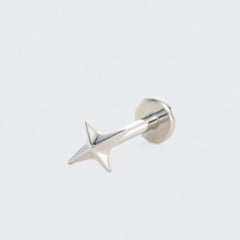
The flat-back exception proves the rule: a 16g labret like the Star Labret in Silver at £10 fills a 16g channel exactly and is pinned between its disc and top, so nothing moves at all — the most comfortable arrangement a piercing can have.
Common gauge mistakes
Forcing a 16g bar into an 18g hole. It tears the channel. Thicker never goes in; stretching is gradual and piercer-led.
Wearing 20g fashion earrings in a 16g cartilage piercing for months. The channel shrinks around them, and the old 16g jewellery stops fitting.
Reading the gauge number backwards. 18g is thinner than 16g, not thicker. Think in millimetres: 1.0mm vs 1.2mm.
Confusing gauge with diameter. A "10mm ring" question is a diameter question; gauge is the post thickness. You need both to order correctly.
Guessing gauge by eye. 0.2mm is invisible across a room and obvious in a channel. Calipers, comparison or the piercer.
Assuming every piercing you have is the same gauge. Lobes at 18g, helix at 16g, navel at 14g is one normal body. Check each.
How Oxies does it
Every listing in our range states its gauge in both formats — 16g and 1.2mm — so there is no decoding at checkout, and the plain hinged clicker comes in 20g, 18g, 16g and 14g with diameters from 6mm to 16mm to match any piercing exactly. Everything is ASTM F136 implant-grade titanium, nickel-free, with gold, rose gold and black finished in PVD bonded into the metal; every order is sterilised and sealed before posting. Pieces start at £9, UK delivery is free over £25, and two pieces save 25% while three or more save 40%, which is how a multi-piercing ear gets every gauge it needs in one order. Browse segment and clicker rings.
Frequently asked questions
Is 16g bigger than 18g?
Yes — 16g is 1.2mm and 18g is 1.0mm, because gauge numbers run backwards: the lower the number, the thicker the jewellery. It is the single most common gauge mix-up. When in doubt, ignore the g-number and compare millimetres.
What gauge are normal earrings?
High-street fashion earrings are usually 20g (0.8mm), and gun-pierced lobes match them. Studio-pierced lobes are more often 18g. That half-size difference is why body jewellery can feel snug in a lobe that has only ever worn fashion earrings — and why a 20g-pierced lobe takes 20g and 18g pieces comfortably but should not be forced into anything thicker.
What gauge is a nose piercing?
Most UK nostril piercings are 18g (1.0mm), with 20g common for daintier studs and 22g (0.6mm) the thinnest made. Septums run thicker, usually 16g. A nostril worn at 20g for a long time may no longer take 18g easily — the shrink-around effect — so match what yours actually wears now, and the nose stud guide covers the shapes.
Can I put an 18g earring in my 16g cartilage piercing?
Yes, it fits — but it sits loose, moves more, and over months the channel can tighten to 18g, after which your 16g jewellery needs a piercer's taper to go back in. For an evening it changes nothing. As a habit, it quietly downsizes the piercing. Decide which you want and wear that gauge on purpose.
Will my piercing shrink if I wear thinner jewellery?
It can — channels adapt to what they hold, so a 16g hole worn at 18g for months may settle at 18g. It is gradual and painless, which is why it goes unnoticed until the old jewellery resists. If you like the piercing at its pierced gauge, wear its pierced gauge; if the thinner piece resists on the way back, that is a taper job, not a push.
How do I stretch from 18g to 16g safely?
With your piercer: one step at a time with a proper taper, on a fully healed piercing, with weeks of settling between steps — never by forcing the bigger bar in. A single gauge step sounds small, but forced stretching tears rather than stretches, and tears scar. If there is any resistance, pain or blood, the tissue was not ready; stop and give it time.
What is 1.2mm in gauge — and do sizes differ in the UK?
1.2mm is 16g, and no — gauge sizes are the same system in the UK, US and EU, though European sellers often list in millimetres instead. The conversions worth memorising: 0.8mm = 20g, 1.0mm = 18g, 1.2mm = 16g, 1.6mm = 14g. A UK listing in millimetres and a US listing in gauge can describe the identical piece.
What gauge should I buy if I am not sure?
Find out before buying: ask the studio that pierced you, measure a piece that fits with calipers, or have any piercer check — guessed gauge is the main cause of jewellery that will not fit. If the piercing is a UK studio cartilage, septum or lip piercing, 16g is the likely answer; lobes are likely 18g. But likely is not certain, and the message to your studio is free.
Key takeaways
- Gauge runs backwards: 20g = 0.8mm, 18g = 1.0mm, 16g = 1.2mm, 14g = 1.6mm. Lower number, thicker bar — think in millimetres.
- Standard fits: lobes 18–20g, nostrils 18–20g, cartilage/septum/lip 16g, navel and industrial 14g. Your piercer's record beats the convention.
- Thinner fits but sits loose, and the channel can shrink around it over months. Wear a thinner gauge by choice, not by accident.
- Thicker never goes in. Sizing up is stretching: piercer, taper, one step, weeks of patience — and nothing is ever forced.
- Jewellery that resists on the way back in means a taper at the piercer, not a harder push.
- Gauge mistakes show fastest on rings, which move; flat-backs that fill the channel exactly are the comfort benchmark.
- A multi-gauge design — one clicker in 20g, 18g, 16g and 14g — lets every piercing wear its exact size.
- Measure, compare or ask; never judge 0.2mm by eye.
Match every piercing to its exact gauge: browse titanium clicker rings in 20g to 14g from £9, sterilised and posted free in the UK on orders over £25.