Quick Answer: Most septum piercings are 16g (1.2mm), with 14g (1.6mm) the next most common. The ring size that matters is inner diameter: 8mm fits the majority of people and sits just below the tip of the nose, 6mm is a snug fit for a high piercing or a small nose, and 10mm hangs lower for a more visible look. To find yours, measure from the piercing hole to the bottom edge of the septum and add 1mm to 2mm. A hinged clicker or a horseshoe are the easiest styles to fit and to flip up.
Informational only, not medical advice. If a piercing is hot, swollen, weeping or increasingly painful, see your piercer or GP.
Septum rings are sold by two numbers and most people only know one of them. The gauge is usually right because you buy what you were pierced with. The inner diameter is where it goes wrong: a ring that is 2mm too big hangs into your lip line, and one that is 2mm too small pinches the tip of your nose. Both are avoidable with a ruler and two minutes.
This guide covers gauge, how to measure your own septum, what each diameter actually looks like on a face, which ring style to choose, how to hide the piercing, and when you can start changing it.
What gauge is a septum piercing?
16g (1.2mm) is the most common gauge in UK studios, with 14g (1.6mm) close behind. Some piercers use 18g on a small septum, but it is unusual. Ask your studio, or measure the bar of the jewellery you were pierced with.
The septum is pierced through the "sweet spot", a thin band of soft tissue between the nostrils just in front of the cartilage. It is soft tissue, which is why it heals faster than ear cartilage and why it tolerates a ring from day one. Gauge choice is mostly piercer preference: 16g gives a finer look and more jewellery choice, 14g is a little sturdier and holds heavier rings better.
| Gauge | Millimetres | How common for septum | Notes |
|---|---|---|---|
| 18g | 1.0mm | Uncommon | Very fine; small noses or a delicate look |
| 16g | 1.2mm | Most common | Widest range of rings and clickers |
| 14g | 1.6mm | Common | Slightly chunkier; better for heavy statement rings |
| 12g and up | 2.0mm+ | Stretched septums only | Requires gradual stretching |
You can wear a thinner gauge in a healed septum, so a 16g ring goes into a 14g piercing (it will feel a little loose). The reverse does not work: 14g will not fit a 16g septum without stretching. For the full gauge chart see the Body Jewellery Size Chart.
What size septum ring do I need?
8mm inner diameter suits most people. 6mm if your piercing sits high or your nose is small, 10mm if it sits lower or you want the ring to show more, and 12mm or above for a deliberate statement. The number is the gap inside the ring, not the outside width.
The ring hangs from the piercing hole, so the diameter decides where the bottom of the ring sits in relation to your upper lip. The distance from the hole to the bottom edge of the septum is the fixed part; the clearance you add is the style choice.
| Hole to bottom of septum | Snug (just clears) | Standard (small gap) | Visible (hangs below the nose) |
|---|---|---|---|
| Under 5mm (high piercing, small nose) | 6mm | 7mm | 8mm |
| 5mm to 7mm (most people) | 7mm | 8mm | 10mm |
| 7mm to 9mm (lower piercing, larger nose) | 8mm | 10mm | 12mm |
| Over 9mm | 10mm | 12mm | 14mm |
If you already own a ring that sits how you like it, measure across the inside of that ring and buy the same number. If you own one that hangs too low, go down 2mm; too tight, go up 2mm.
How do I measure my septum for a ring?
With a ruler: measure from the centre of the piercing hole straight down to the bottom edge of the septum, in millimetres, and add 1mm to 2mm. With a ring you already own: close it and measure across the inside at the widest point. Either takes a minute in front of a mirror.
- Stand in front of a mirror with good light and tilt your head back slightly so you can see the underside of your nose.
- Hold a ruler with millimetre markings vertically against the septum, with the zero at the centre of the piercing hole.
- Read the measurement at the bottom edge of the septum, where the tissue ends between the nostrils. For most people it is 5mm to 7mm.
- Add 1mm for a snug fit or 2mm for a standard fit. That number is your inner diameter.
- If you are between two sizes, choose the larger for a clicker (the straight top bar sits inside the septum and needs a little room) and the smaller for a horseshoe (the gap gives you slack).
To measure an existing ring instead, take it out, close it, and measure across the inside from edge to edge, not including the metal. A hinged clicker measures from the inside of the straight bar to the inside of the bottom of the ring.
A simple check before you buy: hold the ruler horizontally under your nose at the distance you have calculated, and see whether that is where you want the bottom of the ring to sit.
6mm vs 8mm vs 10mm: how does each look?
6mm tucks up close to the tip of the nose and is almost hidden from the front. 8mm sits just below the tip with a small gap and is the size most people picture when they think of a septum ring. 10mm hangs clearly below the nose and reads as a statement. The difference of 2mm is far more visible on a septum than anywhere else on the body.
| Diameter | How it sits | Best for | Watch out for |
|---|---|---|---|
| 6mm | Tight against the tip, ring barely visible from the front | High piercings, small noses, subtle look, work settings | Can pinch if the piercing is low; hard to flip up |
| 7mm | Snug with a hair of clearance | Between-sizes, small noses that want a little visibility | Not every design comes in 7mm |
| 8mm | Small gap below the tip, ring clearly visible but neat | Most people, most piercings, first ring | Very little; the safe default |
| 9mm | Slightly lower than 8mm | Larger noses wanting a standard look | Uncommon size |
| 10mm | Hangs below the nose, visible from every angle | Lower piercings, bold look, chunky designs | Touches the lip line on a small nose; catches on cups |
| 12mm and up | Statement ring well below the nose | Deliberately large, stretched septums, heavy designs | Weight pulls on the piercing; not for healing |
A plain ring is the easiest way to test a size. The Segment Clicker Ring in Gold comes in every size from 6mm to 16mm and in 14g, 16g, 18g and 20g, so whatever gauge you were pierced at, you can buy the exact diameter the ruler gave you.

Which type of ring is best for a septum: clicker, horseshoe or seamless?
A hinged clicker is the best everyday septum ring: it has a straight top bar that sits comfortably inside the septum, it clicks shut with no seam to align, and it holds a decorative front. A horseshoe is the easiest to fit and the easiest to flip up. A seamless ring looks cleanest but has to be twisted open and is the hardest to change yourself. Most piercers fit a horseshoe first and people move to a clicker later.
| Hinged clicker | Horseshoe (circular barbell) | Seamless ring | |
|---|---|---|---|
| Fitting yourself | Easy: open, feed through, click | Easiest: unscrew a ball | Hardest: twist open sideways |
| Comfort inside the septum | Straight bar sits flat; very comfortable | Round bar; fine | Round bar; fine |
| Flipping up to hide | Possible with 8mm and above | Easiest; the gap lets it rotate freely | Possible but tight |
| Look | Clean front, hinge hidden inside | Two balls and a visible gap | Continuous ring |
| Decorative options | Widest: gems, shapes, clusters on the front | Decorative balls only | Plain or beaded |
| Suitable for a fresh septum | Not usually; piercers fit horseshoes | Yes, standard initial jewellery | Rarely |
| Sizing forgiveness | Needs the right diameter | Gap gives some slack | Needs the right diameter |
A clicker like the Floral Face Segment Hinged Clicker Ring in Silver puts the detail on the front face and keeps the straight bar plain, which is what you want inside the nose.

For a horseshoe, the Circular Barbell with Balls CZ Front Facing Horseshoe in Silver is a standard 16g septum piece in 8mm and 10mm.

For the full comparison of hinged, seamless and segment rings, see our upcoming guide Segment Rings vs Clicker Rings vs Seamless Rings: Which Should You Buy?
Can I hide my septum piercing?
Yes. A horseshoe flips up inside the nose and disappears. A clicker of 8mm or more can usually be rotated up too. For a healing piercing, ask your piercer for a septum retainer, a U-shaped piece designed to sit hidden. Flipping is fine once healed; during healing, flip as little as possible.
To flip a horseshoe, hold both balls and rotate the ring upward until the two ends sit inside the nostrils. The gap between the balls is what makes this easy. A clicker has a continuous ring so it needs to rotate as a whole; 8mm and 10mm usually go, 6mm often will not because there is no room for the ring to pass the tip of the septum.
Flipping a healing septum drags the jewellery through the channel and is best kept to a minimum. If you need it hidden for work in the first two to three months, a retainer fitted by your piercer is the answer rather than flipping a ring several times a day.
When can I change my septum ring?
A septum usually heals in 2 to 3 months, and most piercers will change the initial jewellery from about 8 weeks. Changing it yourself is reasonable from 3 months if the piercing is comfortable, and a good many people do it earlier with a piercer's blessing because the septum is soft tissue. A hinged clicker is the easiest first swap.
The initial jewellery is usually a 16g horseshoe at 8mm or 10mm, or a retainer. Once healed, everything in this guide is open to you. The changing guide covers horseshoes and hinged rings step by step. The one thing to remember with a septum is angle: the piercing runs slightly upward toward the tip of the nose, so feed the ring in following that angle rather than straight back.
Do thicker or statement rings need a bigger diameter?
Usually, yes. A chunky ring or one with a large front decoration takes up more of the inside of the ring, so the same inner diameter sits tighter and hangs lower than a plain one. Go up 1mm to 2mm on a heavy design compared with what fits you in a plain ring.
The inner diameter is measured on the ring itself, not the decoration. A cluster or a hanging element on the front adds to the visible drop below the nose without changing the stated size. A design such as the Chain & Spike Hinged Segment Hoop Ring in Silver hangs further than its 8mm suggests because the detail sits below the ring. If a plain 8mm sits where you like it, an 8mm decorated ring will sit slightly lower and a 10mm one noticeably so.

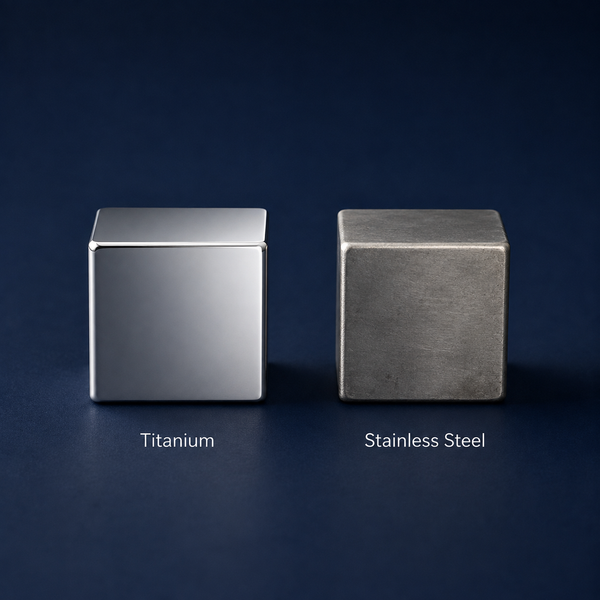
Weight matters too. Titanium is roughly half the weight of steel for the same design, which is the difference between a statement septum ring that you forget about and one that you feel by the afternoon.
Common septum sizing mistakes
Measuring the outside of a ring. The inner diameter is the gap inside. The outside includes the metal and reads 2mm to 3mm bigger.
Buying 10mm because it is the "normal" size. 8mm is the most common fit. 10mm hangs into the lip line on a lot of noses.
Buying 6mm to be discreet, then finding it will not flip up. A 6mm ring often cannot rotate past the tip of the septum. If you need to hide it, 8mm with a horseshoe flips more easily.
Forgetting the gauge. 16g and 14g look similar on a listing. Check the bar thickness; 14g will not fit a 16g piercing.
Assuming a decorated ring sits like a plain one. Front detail hangs lower. Go up a size on heavy designs, or down a size if you want the detail where the plain ring sat.
Feeding the ring straight back. The septum runs slightly upward. Follow the angle or it will not go.
Flipping a healing septum all day. Retainer for the first few months, then flip freely once healed.
How Oxies does it
Every septum ring we sell is ASTM F136 implant-grade titanium, so it is nickel-free, safe for a healing septum and light enough that a statement ring does not pull. Plain hinged clickers come in every inner diameter from 6mm to 16mm and in 14g, 16g, 18g and 20g, so you can buy the exact size your measurement gives you. Decorated clickers and horseshoes are 16g in 8mm and 10mm, the two sizes most septums take. Every order is sterilised before it is posted. Septum rings start at £10, UK delivery is free over £25, and two pieces save 25% while three or more save 40%. Browse septum jewellery.
Frequently asked questions
Is 8mm or 10mm better for a septum?
8mm for most people. It sits just below the tip of the nose with a small gap and is the size the majority of septums are pierced and fitted with. 10mm hangs lower and is right if your piercing sits further from the bottom of the septum, if you have a larger nose, or if you want the ring to be more visible.
How do I know if my septum ring is 16g or 14g?
Measure the thickness of the bar: 1.2mm is 16g, 1.6mm is 14g. If you have no calipers, a 14g bar is visibly thicker, about the same as a standard paperclip, while 16g is noticeably finer. Your studio will also have it on record. If in doubt, 16g fits both, though it will feel loose in a 14g piercing.
What is the smallest septum ring size?
6mm is the smallest inner diameter in common use, and 5mm exists for very high piercings. Below 6mm the ring cannot pass around the tip of the septum comfortably and will not flip up. Most people find 6mm tight and 7mm or 8mm the practical minimum.
Can I wear a 16g ring in a 14g septum?
Yes, once healed. 16g is thinner than 14g so it fits easily and may feel slightly loose or move more than you are used to. The reverse, a 14g ring in a 16g septum, requires stretching and should not be forced.
Why does my septum ring hang crooked?
Either the piercing itself is slightly off-centre, which is common and only noticeable with a ring, or the ring is too large and is swinging to one side. Try a 2mm smaller diameter first; a snugger ring has less room to sit off-line. If a smaller ring still hangs crooked, it is the piercing angle and a clicker with a straight top bar will sit straighter than a round horseshoe.
Do septum clickers come in 6mm?
Yes. Plain clickers are made from 6mm up. Decorated clickers are usually 8mm and 10mm only because the front design needs room. If you need a small size, buy a plain clicker and accept that most gem-fronted styles start at 8mm.
How do I flip my septum ring up?
For a horseshoe, hold both balls and rotate the ring upward so the ends sit inside the nostrils. For a clicker, rotate the whole ring upward; 8mm and larger usually go, 6mm often does not. Do not flip a healing septum repeatedly; use a retainer instead until it has healed.
What size septum ring did I get pierced with?
Almost certainly a 16g or 14g horseshoe at 8mm or 10mm, or a retainer. If you still have it, measure the inside. If not, your studio has it on record, and 8mm is the safe guess for a first replacement.
Key takeaways
- Septums are usually 16g (1.2mm) or 14g (1.6mm). Check the bar thickness before buying.
- The size that matters is inner diameter: the gap inside the ring, not the outside width.
- Measure from the piercing hole to the bottom of the septum and add 1mm to 2mm. Most people land on 7mm or 8mm.
- 6mm is snug and near-hidden, 8mm is the standard fit, 10mm hangs visibly below the nose.
- Hinged clickers are the most comfortable and easiest everyday ring. Horseshoes are easiest to fit and to flip up.
- Decorated rings hang lower than plain ones of the same size. Adjust by 1mm to 2mm.
- 6mm rings often will not flip up. If you need to hide it, 8mm horseshoe or a retainer.
- The septum runs slightly upward. Feed rings in at that angle.
Found your size? Browse titanium septum clickers and horseshoes from £10, in every diameter from 6mm to 16mm, sterilised and posted free in the UK on orders over £25.