Quick Answer: Body jewellery is sized by three numbers. Gauge is the thickness of the bar (16g = 1.2mm, 18g = 1.0mm, 14g = 1.6mm). Inner diameter is the space inside a ring, usually 6mm to 12mm. Length is the wearable bar on a labret or barbell, usually 6mm to 10mm. Most UK cartilage, septum, daith, conch and lip piercings are done at 16g, while lobes and nostrils are often 18g or 20g. If you know your gauge and one of the other two numbers, you can buy the right piece every time.
Informational only, not medical advice. If a piercing is hot, swollen, weeping or increasingly painful, see your piercer or GP.
Buying the wrong size is the single most common reason a new piece of jewellery goes back in the drawer. A ring that is too big spins and catches, a labret that is too long flops around, and a bar that is too thick simply won't go through. None of that is your fault. The sizing system was designed for piercers, not shoppers, and nobody explains it at the counter.
This guide fixes that. It covers what each measurement means, gives you a chart for every common piercing, and shows you how to measure jewellery you already own so you never have to guess again.
What do gauge, diameter and length actually mean?
Gauge is thickness, diameter is the hole in a ring, and length is the straight bar on a stud. Every piece of body jewellery is described by its gauge plus one of the other two, depending on its shape.
Gauge comes from an old wire-measuring system where a smaller number means a thicker wire. That is the part that confuses everyone: 14g is thicker than 16g, and 16g is thicker than 18g. In the UK you will increasingly see the millimetre figure instead, which is far easier to read.
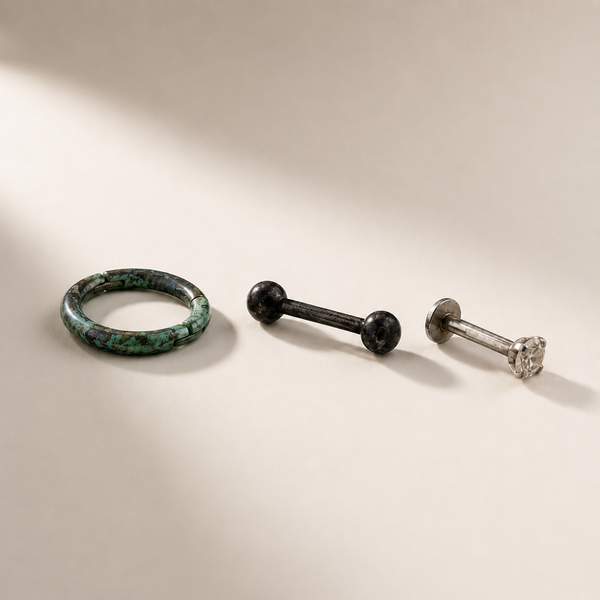
Inner diameter applies to rings, hoops, segment rings, clickers and circular barbells. It is measured across the inside of the ring from edge to edge, not the outside. An 8mm ring has an 8mm gap inside it.
Length applies to labret studs, straight barbells and curved barbells. It is the wearable section of the post between the two ends, so the ball or disc does not count. A labret listed as 8mm has 8mm of bar sitting through your piercing.
| Measurement | Applies to | What it measures | Typical range |
|---|---|---|---|
| Gauge | Everything | Thickness of the bar or wire | 20g (0.8mm) to 14g (1.6mm) |
| Inner diameter | Rings, hoops, clickers, horseshoes | Gap across the inside of the ring | 6mm to 12mm |
| Length | Labrets, straight and curved barbells | Wearable bar between the ends | 6mm to 38mm |
| Ball or disc size | Studs and barbells | Width of the decorative end | 2mm to 5mm |
Gauge to millimetre conversion chart
16g is 1.2mm, 18g is 1.0mm, 14g is 1.6mm, and 20g is 0.8mm. Those four cover almost every piercing you are likely to have.
| Gauge | Millimetres | Common piercings |
|---|---|---|
| 20g | 0.8mm | Nostril, lobe (fine studs) |
| 18g | 1.0mm | Lobe, nostril, some helix |
| 16g | 1.2mm | Helix, tragus, conch, daith, rook, septum, lip, eyebrow |
| 14g | 1.6mm | Industrial, navel, tongue, nipple, bridge, some septum |
| 12g | 2.0mm | Stretched lobes and septums |
| 10g | 2.5mm | Stretched piercings |
Some brands list sizes as fractions of an inch, which is an American convention. If you see 3/8" that is 10mm, 5/16" is 8mm, and 1/4" is 6mm. UK stores, including this one, list everything in millimetres.
What gauge is my piercing?
In the UK, almost all cartilage and facial piercings are done at 16g (1.2mm), while lobes and nostrils are most often 18g (1.0mm) or 20g (0.8mm). The safest way to confirm is to ask the studio that pierced you, but this table reflects what the large majority of UK piercers use.
| Piercing | Standard gauge | Also seen | Notes |
|---|---|---|---|
| Lobe | 18g (1.0mm) | 20g, 16g | Studio piercings often 16g; gun piercings usually 20g |
| Helix | 16g (1.2mm) | 18g | Upper ear cartilage |
| Forward helix | 16g (1.2mm) | 18g | Small anatomy, short posts |
| Tragus | 16g (1.2mm) | 18g | |
| Anti-tragus | 16g (1.2mm) | ||
| Conch | 16g (1.2mm) | 14g | Some piercers prefer 14g for large hoops |
| Daith | 16g (1.2mm) | 14g | |
| Rook | 16g (1.2mm) | Curved barbell initially | |
| Snug | 16g (1.2mm) | ||
| Industrial | 14g (1.6mm) | 16g | Long straight barbell |
| Nostril | 18g (1.0mm) | 20g, 16g | UK studios increasingly use 16g |
| Septum | 16g (1.2mm) | 14g | |
| Bridge | 14g (1.6mm) | 16g | |
| Eyebrow | 16g (1.2mm) | 14g | |
| Lip, labret, Monroe, Medusa | 16g (1.2mm) | 14g | |
| Tongue | 14g (1.6mm) | ||
| Navel | 14g (1.6mm) | ||
| Nipple | 14g (1.6mm) | 16g |
If you were pierced with a gun at a high-street shop, assume 20g. If you were pierced with a needle at a studio, assume 16g for anything on the cartilage or face and 18g for a lobe, then confirm.
What diameter ring do I need?
Most ear cartilage and septum piercings take an 8mm or 10mm inner diameter, nostrils take 6mm to 8mm, and conch hoops need 10mm to 12mm. The right diameter depends on how far the piercing sits from the edge of the tissue.
A ring should sit with a small amount of room to move, roughly 1mm to 2mm of clearance between the ring and the edge of your ear or nose. Too tight and it presses on the healing channel. Too loose and it rotates, catches on hair and clothing, and looks oversized.
| Piercing | Snug fit | Standard fit | Loose or statement fit |
|---|---|---|---|
| Nostril | 6mm | 7mm to 8mm | 10mm |
| Septum | 6mm to 8mm | 8mm to 10mm | 12mm |
| Helix | 6mm to 8mm | 8mm to 10mm | 12mm |
| Forward helix | 5mm to 6mm | 6mm | 8mm |
| Tragus | 6mm | 8mm | 10mm |
| Daith | 8mm | 8mm to 10mm | 12mm |
| Rook | 6mm | 8mm | 10mm |
| Conch (outer) | 10mm | 11mm to 12mm | 14mm |
| Lobe | 6mm to 8mm | 8mm to 10mm | 12mm |
| Lip | 8mm | 8mm to 10mm | 12mm |
When you are unsure, 8mm is the size to start with for the ear and septum. It fits the majority of people and is the most stocked size for a reason. A 16g segment ring such as the White Opal & Clear CZ Side Facing Paved Hinged Segment Hoop Ring in Silver comes in 6mm, 8mm, 10mm and 12mm, so you can match the fit rather than compromise.

For a full breakdown of which ring style suits which piercing, see our upcoming guide Segment Rings vs Clicker Rings vs Seamless Rings: Which Should You Buy?
What length labret or barbell do I need?
Healed cartilage, tragus and conch piercings usually take a 6mm to 8mm labret, fresh piercings are fitted longer at 8mm to 10mm, and industrials need 32mm to 38mm. Length is the number people get wrong most often, because it changes as the piercing heals.
When you are first pierced, tissue swells. Your piercer fits a longer bar to allow for that. Once the swelling goes down, typically after four to eight weeks, the bar looks too long and needs downsizing. Wearing a long bar after healing is the most common cause of the piercing angle drifting and of irritation bumps.
| Piercing | Fresh (allowing for swelling) | Healed | Jewellery type |
|---|---|---|---|
| Helix | 8mm | 6mm | Labret stud |
| Forward helix | 6mm to 8mm | 5mm to 6mm | Labret stud |
| Tragus | 8mm | 6mm | Labret stud |
| Conch (inner) | 8mm to 10mm | 6mm to 8mm | Labret stud |
| Lobe | 8mm | 6mm | Labret stud |
| Nostril | 7mm to 8mm | 6mm | Labret or nose stud |
| Lip, Monroe, Medusa | 10mm | 8mm | Labret stud |
| Eyebrow | 10mm | 8mm | Curved barbell |
| Rook | 8mm | 6mm | Curved barbell |
| Navel | 10mm to 12mm | 10mm | Curved barbell |
| Industrial | 38mm | 32mm to 38mm | Straight barbell |
| Tongue | 19mm | 14mm to 16mm | Straight barbell |
| Nipple | 14mm to 16mm | 12mm to 14mm | Straight barbell |
The labrets in our range are 16g with an 8mm wearable length, which is the standard healed size for conch and lip piercings and a comfortable everyday length for helix, tragus and rook. The Single Marquise Red Onyx Labret in Silver is a good example of a flat-back stud in that spec.

Industrials are a special case. The bar has to span two holes in the cartilage, so length is measured hole to hole and varies with your ear. Our Double Triangle CZ Industrial Barbell is 14g at 38mm, which fits the majority of adult ears, but measure your current bar first.

How do I measure jewellery I already own?
Measure the bar with a ruler or digital calipers, then compare the thickness to the gauge chart and read the length or inner diameter directly in millimetres. If you have one piece that fits well, you have everything you need.
For gauge, lay the bar flat against a ruler with millimetre markings. A 1.2mm bar is noticeably thicker than a standard sewing pin and about the same as a paperclip wire. If you want certainty, a set of digital calipers costs a few pounds online and removes all doubt.
For inner diameter, measure across the inside of the ring at its widest point, edge to edge. Do not include the metal of the ring itself. For a hinged segment ring, close it first so the circle is complete.
For labret length, measure the post from the inside face of the flat disc to where the removable top screws or pushes on. Do not include the disc or the decorative end. For a barbell, measure the bar between the two balls.
Take a photo of your measurement next to the ruler and keep it. It saves you re-measuring every time you shop.
What happens if I buy the wrong size?
Too thick won't go in, too thin can migrate or cause irritation, too long catches and drifts, and too small a ring pinches the piercing. None of these are dangerous in the short term, but all of them make the piercing harder to keep happy.
| Mistake | What you'll notice | Fix |
|---|---|---|
| Gauge too thick (14g in a 16g hole) | Jewellery won't go through, forcing it tears the channel | Buy the correct gauge; never force it |
| Gauge too thin (18g in a 16g hole) | Loose feel, jewellery moves in the hole, possible irritation | Go back to 16g |
| Ring diameter too small | Pressure on the piercing edge, ring sits at an angle | Size up 2mm |
| Ring diameter too large | Spins, catches on hair, looks oversized | Size down 2mm |
| Labret too long | Bar sticks out, catches, angle drifts over time | Downsize to healed length |
| Labret too short | Disc sinks into the skin, pressure and swelling | Size up 2mm immediately |
Going one gauge thinner is generally fine once healed. A 16g piercing will accept an 18g piece without issue, though it may feel slightly loose. Going thicker is not fine. Stretching a piercing is a gradual process and forcing a 14g bar through a 16g hole is how people end up with tears and scar tissue.
Common sizing mistakes
Reading gauge backwards. Remember that a smaller gauge number is a thicker bar. 14g is thick, 20g is thin. If in doubt, ignore the gauge and use the millimetre figure.
Measuring outer diameter instead of inner. A ring's outer edge includes the thickness of the metal on both sides, so it reads 2mm to 3mm larger than the inner diameter. Always measure inside.
Including the ends in the length. Labret length is bar only. If you measure from the tip of the gem to the outside of the disc you will buy something far too short.
Buying the fresh-piercing length for a healed piercing. Your piercer fitted a long bar on purpose. Once healed, downsize. If it has been more than three months and your bar still sticks out, it is too long.
Assuming every piercing on your body is the same gauge. A lobe done at a shopping centre and a helix done at a studio can be two different gauges on the same ear. Check each one.
Trusting a listing that shows a size in inches. Convert it. 5/16" is 8mm, 3/8" is 10mm. The difference between them is enough to make a ring sit badly.
How Oxies does it
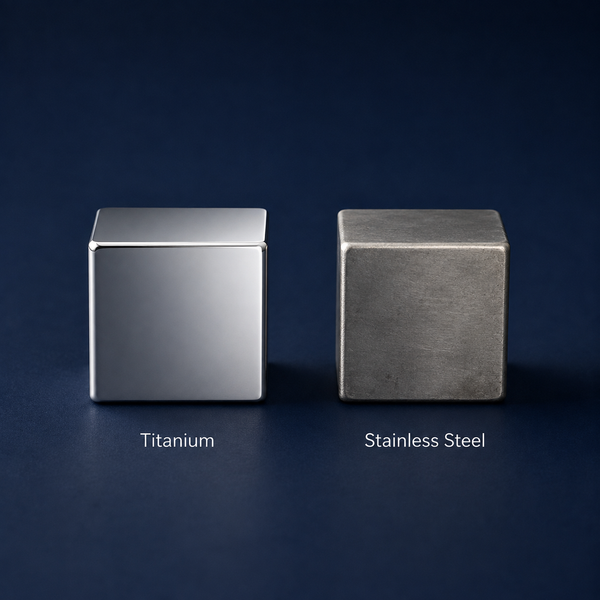
Every piece we sell is made from ASTM F136 implant-grade titanium, the same alloy used in surgical implants, so it is nickel-free and safe for healed and healing piercings alike. Sizes are listed in millimetres on every product, with the gauge given as both a number and its mm equivalent, so there is nothing to convert. Segment rings and clickers come in 6mm, 8mm, 10mm and 12mm inner diameters at 16g, and labrets are 16g at 8mm. Every order is sterilised before it is sent. UK delivery is free over £25, and if you are buying for more than one piercing, two pieces save 25% and three or more save 40%. Browse the full titanium range.
Frequently asked questions
What gauge is a 1.2mm piercing?
1.2mm is 16 gauge (16g). It is the most common size for helix, tragus, conch, daith, rook, septum and lip piercings in the UK. If your piercer said 1.2mm, buy 16g jewellery.
Is 16g bigger than 18g?
Yes. 16g (1.2mm) is thicker than 18g (1.0mm). Gauge numbers run backwards, so the smaller the number, the thicker the bar. A 16g piercing will accept 18g jewellery, but an 18g piercing will not comfortably take 16g.
What size ring do I need for a helix?
Most helix piercings take an 8mm inner diameter at 16g. Use 6mm if your piercing sits very close to the edge of the ear, and 10mm if it sits further in or you want a looser look. Measure the distance from the hole to the ear edge and add 1mm to 2mm of clearance.
What size labret do I need for a conch?
A healed inner conch usually takes a 16g labret at 6mm to 8mm. Fresh conch piercings are fitted at 8mm to 10mm to allow for swelling. If your current post sticks out well past the back of your ear, it is time to downsize.
How do I know what size my nose ring is?
Measure the inside of the hoop in millimetres, and check the bar thickness against a 1mm or 1.2mm reference. Most UK nostril hoops are 6mm to 8mm at 18g or 16g. If a ring fits well now, buy that exact size again.
Can I put a 16g ring in an 18g piercing?
Not without discomfort. 16g is 0.2mm thicker than 18g, and a healed 18g channel will not take it easily. Forcing it can tear the piercing. If you want to wear 16g jewellery, ask your piercer about stretching or repiercing at the larger size.
Does length include the ball?
No. Labret and barbell length is the wearable bar only, between the two ends. The disc, ball or gem is not included. An 8mm labret has an 8mm post, with the decorative top adding a further 2mm to 5mm on the outside.
What is the most common body jewellery size in the UK?
16g (1.2mm) is the single most common size, followed by 18g (1.0mm) for lobes and nostrils. For rings, 8mm is the most common inner diameter. For labrets, 6mm and 8mm are the most common healed lengths. If a UK store only stocked one size, it would be 16g at 8mm.
Key takeaways
- Gauge is thickness: 20g = 0.8mm, 18g = 1.0mm, 16g = 1.2mm, 14g = 1.6mm. Smaller number, thicker bar.
- Inner diameter is the gap inside a ring, measured edge to edge on the inside, not the outside.
- Length is the wearable bar on a labret or barbell, not including the ends.
- Most UK cartilage, septum, daith and lip piercings are 16g. Lobes and nostrils are usually 18g or 20g.
- 8mm is the safest starting diameter for ears and septum; nostrils are 6mm to 8mm; outer conch is 10mm to 12mm.
- Fresh piercings are fitted long to allow for swelling. Downsize once healed, usually after four to eight weeks.
- You can go one gauge thinner once healed. Never force a thicker gauge through a healed hole.
- Measure a piece that already fits well and buy that size again.
Ready to size up your next piece? Browse implant-grade titanium jewellery in every size, with free UK delivery over £25.