Quick Answer: Jewellery turns your skin green because it contains copper, which reacts with sweat to form copper salts. It leaves black marks because of silver tarnish, worn nickel plating, or soft metal rubbing against cosmetics. It goes dull or grey when a plating wears through or when stainless steel pits in chlorine and sweat. Implant-grade titanium (ASTM F136) does none of these: it contains no copper, nickel or silver, needs no plating, and its oxide surface is stable in sweat, salt water and chlorine. If your jewellery has discoloured, it was not titanium, whatever the packaging said.
Informational only, not medical advice. If a piercing is hot, swollen, weeping or increasingly painful, see your piercer or GP.
A green ring around a piercing, a black smudge on the back of an earring, a gold hoop that has gone the colour of a teaspoon: these are the three ways jewellery lets you down, and they have three different causes. None of them is caused by your skin being "too acidic", and none of them is a sign of infection. They are a sign of what the metal is made of.
This guide explains each type of discolouration, which metals cause it, whether it is harmful, how to clean it off, and why one material in particular is immune.
Why does jewellery turn skin green?
Green skin is copper. Copper in the metal reacts with the acids and salts in your sweat, forms green copper compounds on the surface, and those rub off onto you. It is the same chemistry that turns a copper roof green, happening in miniature against your ear or nose.
Copper is in far more jewellery than people realise. Brass is copper and zinc. Bronze is copper and tin. Low-carat gold, and most "gold-tone" or "gold-plated" fashion jewellery, is a copper-based alloy under a very thin gold layer. Once that layer wears through, which on a piercing can take days, the copper beneath is against your skin. The green is harmless and washes off, but it tells you the piece is a base metal, and base-metal jewellery almost always contains nickel too.
Titanium, surgical steel and solid gold above 14 carat do not contain enough copper to do this. If a "titanium" or "steel" piece has turned you green, it was mislabelled.
Why does jewellery go black or leave black marks?
Black discolouration has three common causes: silver tarnishing, nickel or rhodium plating wearing through to a dark base metal, and soft metal being abraded by cosmetics. Which one you have depends on the metal and where the mark appears.
Silver reacts with sulphur in the air, in sweat and in some foods to form silver sulphide, which is black. Sterling silver earrings go dark from the back first, where they touch skin. Silver is not recommended for piercings at all, and for healing piercings it is a real problem: the tarnish can deposit into the healing tissue and leave a permanent grey stain around the hole.
Plated jewellery goes black when the bright top layer wears off and exposes a darker base metal, often nickel or a nickel alloy. That is also the moment nickel reactions tend to start.
The third cause surprises people. Lotions, foundation, sunscreen and some powders contain zinc oxide and titanium dioxide, which are hard mineral particles. Rubbed against a soft metal like gold, they abrade microscopic flecks off the surface, and those flecks show up as a black smudge on your skin. It looks like tarnish but it is actually metal dust. It happens most with gold, less with steel, and almost never with titanium.
| Black mark | Where it appears | Metal | Cause |
|---|---|---|---|
| Dark film over the whole piece | Everywhere, worst where it touches skin | Sterling silver | Silver sulphide tarnish |
| Dark patches at edges and contact points | Ball edges, inside of rings, clasp | Plated base metal | Plating worn through to nickel or dark alloy |
| Smudge on skin, jewellery still bright | Skin, not the jewellery | Gold, some steel | Abrasion by cosmetics containing zinc or titanium oxide |
| Dark line inside a healing piercing | The piercing channel | Silver | Tarnish deposited into tissue; can be permanent |
Why does jewellery go dull or grey?
Dull, grey or cloudy jewellery is usually one of three things: a plating wearing off, stainless steel losing its polish in chlorine and sweat, or a build-up of dried skin, lymph and product that just needs cleaning. The last one is the most common and the easiest to fix.
Plated jewellery loses its shine as the plating thins. A gold-plated hoop that has gone slightly dull and patchy is showing the steel or brass beneath. It will not come back with polishing; the bright layer is gone.
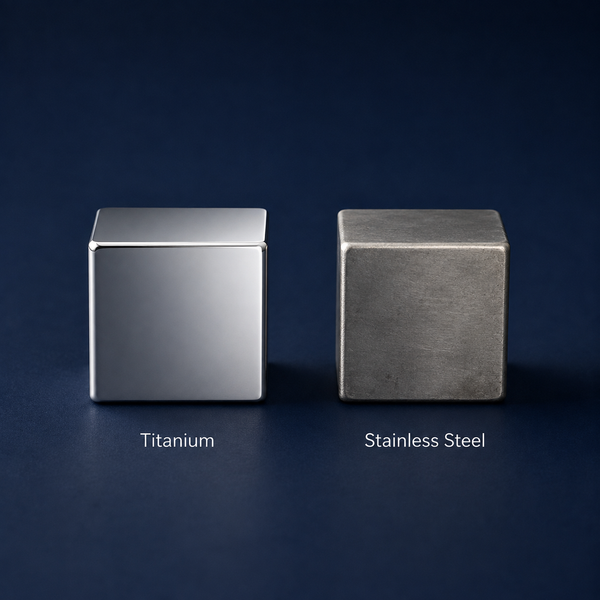
Stainless steel, including 316L "surgical steel", relies on a chromium oxide film for its shine. Chloride ions in pool water, sea water and sweat attack that film over time, and the surface develops fine pits that scatter light and look grey. Cheap steel does this in months; good 316L takes years, but it does happen.
Titanium does not pit and cannot lose a plating because it has none. If a titanium piece looks dull, it is almost always a layer of dried lymph, dead skin and skincare product. Warm water and a soft cloth bring it back.
Does titanium tarnish?
No. Implant-grade titanium does not tarnish, rust, pit, flake or turn skin any colour. The surface of titanium is a thin, transparent layer of titanium dioxide that forms instantly on contact with air and reforms if scratched. That layer is chemically stable in sweat, salt water, chlorine and every cosmetic you are likely to wear.
There is nothing in ASTM F136 titanium to react. No copper to turn green, no silver to go black, no nickel plating to wear through, no chromium film to be attacked by chloride. It is the same reason titanium is used for hip replacements and dental implants: the body cannot corrode it.
Anodised titanium colours are also part of that oxide layer, not a coating. The gold, rose gold and blue finishes on titanium jewellery are made by thickening the oxide layer to a precise depth, which changes the colour of light it reflects. The colour can dull very gradually over years of abrasion, but it cannot chip, peel or expose a different metal beneath. A rose gold titanium ring like the Clear CZ Side Paved Hinged Segment Hoop Ring in Rose Gold is rose gold all the way through, in the sense that matters: scratch it and it is still titanium underneath.

For the full comparison with steel, see Titanium vs Surgical Steel Body Jewellery.
Which metals tarnish and which don't?
Titanium, niobium, platinum and solid gold of 14 carat and above are the metals that stay bright indefinitely. Silver, brass, copper, low-carat gold and anything plated will discolour, and 316L steel sits in the middle. The table below is the short version.
| Metal | Turns skin green | Goes black | Goes dull | Safe in a healing piercing |
|---|---|---|---|---|
| Implant-grade titanium (ASTM F136) | No | No | No (cleans back to bright) | Yes |
| Niobium | No | No | No | Yes |
| Solid 14ct to 18ct gold | No | Rarely (cosmetic abrasion only) | No | Yes, if nickel-free alloy |
| Platinum | No | No | No | Yes |
| 316L "surgical steel" | No | No | Slowly, in chlorine and sweat | Only if ASTM F138 certified |
| 9ct gold | Sometimes | Sometimes | Yes | Not recommended |
| Sterling silver | No | Yes | Yes | No |
| Gold-plated or PVD steel | Rarely | When plating wears | When plating wears | No |
| Gold-plated brass or "gold tone" | Yes | Yes | Yes | No |
| Brass, bronze, copper | Yes | Yes | Yes | No |
| Unlabelled "hypoallergenic" or "nickel-free" alloy | Often | Often | Yes | No |
The last row matters. "Hypoallergenic" and "nickel-free" are not regulated terms on jewellery packaging in the UK. If a piece is not sold with a named material and grade, assume it is a base-metal alloy.
Is green skin or tarnish dangerous?
Green or black skin from jewellery is harmless in itself and washes off. The risk is what it tells you: the piece is a base metal, which usually means nickel, and it is not suitable for a piercing, especially a healing one. The exception is silver in a fresh piercing, which can stain the tissue permanently.
Copper salts on the skin do not cause allergy or infection. Black cosmetic smudge from gold is literally just gold dust. Neither needs treatment beyond washing.
The problems come from what accompanies the discolouration. Brass, bronze and plated base metals contain nickel, and nickel is the most common contact allergy in the UK, affecting roughly one person in ten. A piercing is an open channel through the skin, so a nickel-bearing piece in a piercing is far more likely to sensitise you than a bracelet would. If your piercing itches, reddens, flakes or weeps while wearing a piece that has also discoloured, that is a nickel reaction until proven otherwise.
Silver is a special case. Silver sulphide forming inside a healing piercing can be absorbed into the tissue and leave a permanent grey or blue-black ring around the hole. It is not harmful to health, but it does not go away. This is why no reputable UK piercer will fit silver in a fresh piercing.
If a piercing is hot, swollen, spreading in redness or producing thick yellow or green discharge, that is potentially an infection and needs a piercer or GP, not a metal swap.
How do I clean piercing jewellery that has gone dull?
For titanium, warm water, a drop of mild soap and a soft cloth. For steel, the same, plus a longer soak. For silver, a silver cloth. For plated jewellery, cleaning will not restore a plating that has worn off. Never use bleach, toothpaste, baking soda or anything abrasive on piercing jewellery.
Take the jewellery out before cleaning it if the piercing is healed. If the piercing is still healing, do not remove the jewellery; clean it in place with sterile saline and leave the metal alone.
| Metal | Method | Avoid |
|---|---|---|
| Titanium | Warm water, mild soap, soft cloth or soft toothbrush. Ultrasonic cleaners are fine. | Abrasives (they scratch the finish); harsh chemicals are unnecessary |
| 316L steel | Warm soapy water, soak 10 minutes, soft brush. Dry fully. | Bleach, chlorine, prolonged soaking in salt water |
| Solid gold | Warm soapy water, soft brush. Jeweller's cloth for shine. | Abrasive pastes |
| Silver | Silver polishing cloth. Store in an airtight bag. | Wearing it in a piercing at all |
| Plated | Wipe gently with a damp cloth. | Any polishing; it removes the plating faster |
A soft toothbrush reaches the inside of a hinged ring and the thread of a labret post, which is where dried lymph collects. Rinse and dry fully before putting the piece back in.
How do I stop my jewellery from tarnishing?
Buy a metal that does not tarnish. For everything else: take it off for swimming, showering and sleeping, keep it away from perfume and lotion, wipe it dry after wear, and store it in a sealed bag. That is the whole list, and the first item makes the rest unnecessary.
Chlorine is the fastest way to dull steel and strip plating. Perfume, hairspray and sunscreen applied over jewellery leave a film that traps sweat against the metal and speeds up every reaction above. Sleeping in jewellery presses it against skin for eight hours in a warm, damp environment, which is exactly what copper and silver need to react.
Titanium ignores all of this. You can shower, swim, sleep and apply products with titanium jewellery in and nothing will happen to it. Rinse it now and then so the surface stays clean, and that is the entire maintenance routine. The Circular Barbell with Balls CZ Front Facing Horseshoe in Gold is anodised gold titanium: it looks like a gold hoop and is treated like one, without the plating that a gold-tone steel hoop would lose in a few months.

Is it tarnish, or is it my piercing?
If the discolouration is on the jewellery and comes off with cleaning, it is tarnish or build-up. If it is on the skin around the hole, it is either copper transfer or a skin reaction, and the difference is whether it washes off. A yellowish crust on the jewellery is dried lymph, not tarnish, and is normal during healing.
Lymph is the clear fluid a healing piercing produces. It dries to a pale yellow or off-white crust on the jewellery and around the hole, and it can make a bright piece look dull and grubby. It is not a sign of infection, and it is not the metal changing. Soak with sterile saline and it softens and rinses away.
| What you see | Likely cause | Washes off? | Action |
|---|---|---|---|
| Green ring on skin around the piercing | Copper in the metal | Yes | Change to titanium |
| Green or yellow thick discharge from the hole | Possible infection | No | See a piercer or GP |
| Black smudge on skin, jewellery still bright | Cosmetic abrasion of soft metal | Yes | Apply products before jewellery, or switch to titanium |
| Jewellery gone dark all over | Silver tarnish or worn plating | Silver: with a cloth. Plating: no | Replace with titanium |
| Pale yellow crust on jewellery | Dried lymph | Yes, with saline | Normal; keep cleaning |
| Red, itchy, flaky skin around the hole | Nickel reaction or irritation | No | Change to titanium; see the size chart if the fit is wrong |
| Grey or blue ring in the skin around an old piercing | Silver deposited during healing | No | Permanent; avoid silver in future |
A plain titanium labret like the Single Marquise Red Onyx Labret in Silver is a sensible test piece: if a piercing that reacted to your old jewellery settles down within a week or two in titanium, the metal was the problem.

Myths vs facts
Myth: My skin is acidic, so everything turns green on me. Fact: everyone's sweat is mildly acidic. The difference between people who "turn everything green" and those who do not is usually just how much they sweat and how much copper is in what they wear. Titanium will not turn green on anyone.
Myth: Real gold never tarnishes. Fact: solid gold does not corrode, but 9ct gold is under 40% gold and the rest is copper and silver, which do. And any gold can leave black cosmetic smudges through abrasion.
Myth: Surgical steel can't tarnish because it's stainless. Fact: stainless steel resists rust, but chloride from sweat and pools can pit and dull it over time. It is far better than base metal and far worse than titanium.
Myth: Green skin means the piercing is infected. Fact: green skin is copper. Infection shows as heat, swelling, pain and thick discharge from the hole, not as a tint on the surrounding skin.
Myth: "Nickel-free" on the packet means it won't react. Fact: the term is not regulated for jewellery in the UK. Buy by named material and grade, not by a claim.
Myth: Titanium colours are painted on and will wear off. Fact: anodised colour is an oxide layer that is part of the metal. It can dull very slowly with years of wear but cannot chip, peel or reveal a different metal.
How Oxies does it
Every piece in our range is ASTM F136 implant-grade titanium, which does not tarnish, does not turn skin green or black, and does not lose its colour. The gold, rose gold and blue finishes are anodised into the metal, not plated on top, so there is nothing to wear through. Each order is sterilised before it is posted. Pieces start at £9.99, UK delivery is free over £25, and two pieces save 25% while three or more save 40%. Browse the full titanium range.
Frequently asked questions
Why does my nose ring turn green?
Because it contains copper, which reacts with sweat to form green copper salts that transfer to your skin. Brass, bronze, low-carat gold and most gold-plated fashion jewellery are copper alloys. A nose ring in implant-grade titanium, solid 14ct gold or 316L steel will not turn green.
Does titanium jewellery tarnish?
No. Implant-grade titanium does not tarnish, rust, pit or discolour. Its surface is a stable titanium dioxide layer that reforms if scratched and is unaffected by sweat, chlorine, salt water and cosmetics. If a piece sold as titanium has tarnished, it was not titanium.
Does surgical steel tarnish?
Not in the way silver does, but it can slowly dull and pit. Chloride ions in sweat, swimming pools and the sea attack the chromium oxide film that keeps steel bright. Good 316L takes years to show it; cheap steel can dull in months. Titanium does not dull at all.
Why do my earrings leave black marks on my skin?
Usually one of three things: silver tarnish, plating that has worn through to a dark base metal, or soft gold being abraded by cosmetics containing zinc or titanium oxide. If the mark is on your skin and the earring is still bright, it is the cosmetic effect. If the earring itself is dark, it is tarnish or worn plating.
Is it safe to wear jewellery that turned my skin green?
Green skin is harmless and washes off, but the jewellery is a base metal and should not go in a piercing. Base-metal alloys almost always contain nickel, the most common cause of jewellery allergy, and a piercing is the easiest place to develop that allergy. Switch to titanium.
Can I wear silver in a healing piercing?
No. Silver tarnishes in contact with body fluids, and the black silver sulphide can deposit into healing tissue and leave a permanent grey ring around the piercing. Wait until the piercing is fully healed, and even then titanium or solid gold is the better choice.
Does anodised titanium fade?
Very slowly, with years of abrasion, and it cannot chip or flake. The colour is an oxide layer that is part of the metal, not a coating. Areas that rub constantly, such as the inside of a ring, may soften in tone over a long time. Scratch it and you find titanium beneath, not a different metal.
How do I get the yellow crust off my piercing jewellery?
That crust is dried lymph, not tarnish. Soak the area with sterile saline or spray it, let the crust soften, and rinse it away. Do not pick it and do not remove the jewellery from a healing piercing to clean it. Once the piercing is healed, take the piece out and wash it in warm soapy water with a soft toothbrush.
Key takeaways
- Green skin is copper. Black marks are silver tarnish, worn plating or cosmetic abrasion. Dullness is worn plating, pitted steel or plain dirt.
- None of these are caused by your skin chemistry. They are caused by what the jewellery is made of.
- Discolouration is harmless in itself, but it tells you the piece is a base metal, which usually means nickel.
- Silver in a healing piercing can leave a permanent grey stain in the skin. Do not use it.
- "Hypoallergenic" and "nickel-free" are not regulated terms in the UK. Buy by named material and grade.
- 316L steel resists tarnish but can pit and dull in chlorine and sweat over time.
- Implant-grade titanium does not tarnish, turn skin green or lose its colour. Anodised finishes are part of the metal, not a coating.
- Clean titanium with warm soapy water and a soft brush. A yellow crust on healing jewellery is lymph, not tarnish.
Done with green skin and black smudges? Browse implant-grade titanium jewellery from £9.99, with free UK delivery over £25.