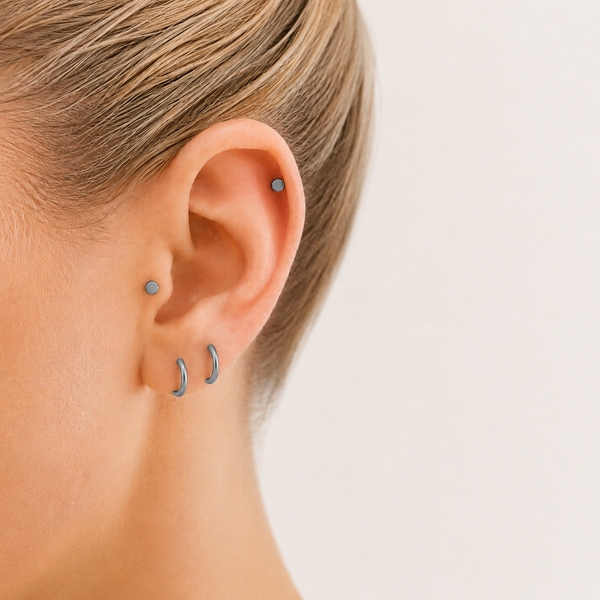
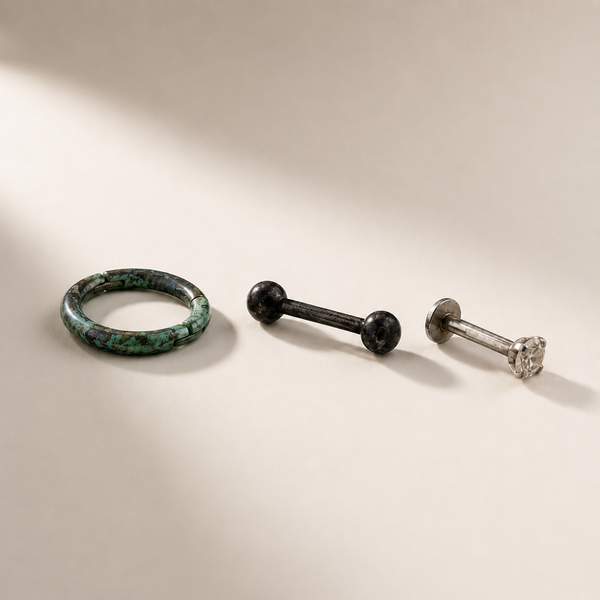
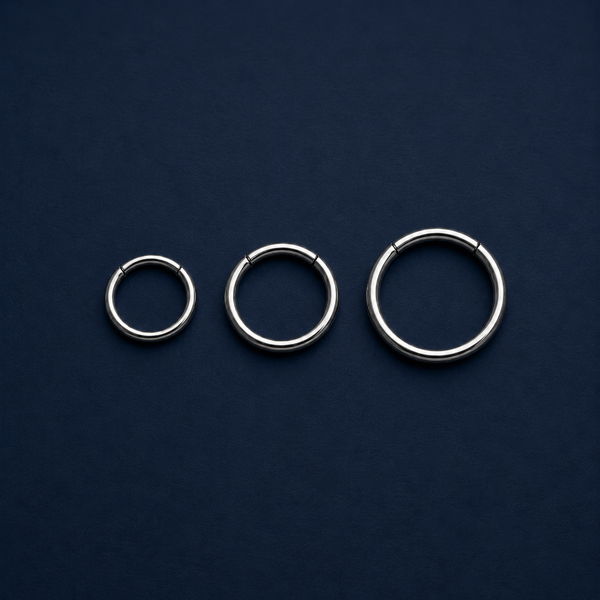
Quick Answer: Implant-grade titanium (ASTM F136) is the better metal for piercings. It contains no nickel, while so-called surgical steel (316L) is roughly 10% to 14% nickel by weight. Titanium is about 45% lighter, holds colour through anodising rather than a coating that wears off, and is the metal the Association of Professional Piercers recommends for fresh piercings. Surgical steel is cheaper and perfectly wearable for many people in healed piercings, but if you have ever had a reaction to jewellery, or you are healing a new piercing, titanium is the safer choice.
Informational only, not medical advice. If a piercing is hot, swollen, weeping or increasingly painful, see your piercer or GP.
Walk into any high-street shop and "surgical steel" is printed on the packaging as though it settles the question. It sounds medical, it sounds safe, and for a lot of people it is fine. But the phrase has no legal definition, most of what is sold under it has never been near an operating theatre, and it contains the single most common cause of jewellery allergies in the UK.
This guide compares the two metals on the things that matter: what they are made of, how they behave in a healing piercing, how they feel to wear, how they hold colour, and what they cost. It ends with a plain answer on which to buy.
What is the difference between titanium and surgical steel?
Titanium body jewellery is a titanium alloy with no nickel in it. Surgical steel is a stainless steel alloy that relies on nickel for its shine and corrosion resistance. That single difference drives almost everything else in this comparison.
"Implant-grade titanium" means the alloy meets ASTM F136, a specification written for surgical implants. The alloy is Ti-6Al-4V ELI: roughly 90% titanium, 6% aluminium, 4% vanadium, with the ELI (extra low interstitial) part controlling impurities. It is the material used in hip replacements, dental implants and bone screws.
"Surgical steel" almost always means 316L stainless steel, or occasionally 316LVM. The implant version of this steel is ASTM F138. Very little body jewellery sold as surgical steel is certified to F138, and the term is applied freely to any shiny steel alloy.
| Implant-grade titanium | Surgical steel | |
|---|---|---|
| Standard | ASTM F136 (Ti-6Al-4V ELI) | 316L / 316LVM; ASTM F138 if implant certified |
| Nickel content | None | Around 10% to 14% |
| Chromium | None | Around 16% to 18% |
| Density | About 4.4 g/cm³ | About 8.0 g/cm³ |
| Colour options | Anodised (oxide layer, no coating) | Plated or PVD coated |
| Magnetic | No | Very slightly, depending on grade and finishing |
| Typical UK price per piece | From about £10 | From about £3 |
| APP approved for fresh piercings | Yes | Only if certified ASTM F138 |
Does surgical steel contain nickel?
Yes. 316L surgical steel contains roughly 10% to 14% nickel by weight, and that is not a contaminant, it is part of the recipe. Nickel is what keeps the steel bright, non-rusting and easy to polish.
The argument in favour of surgical steel is that the nickel is bound within the alloy and releases slowly. That is partly true. UK and EU REACH regulations limit nickel release from piercing posts to 0.2 micrograms per square centimetre per week, and well-made 316L can pass that test. Cheap or poorly finished 316L, and the many unlabelled alloys sold as "surgical steel", often do not.
There are two problems with relying on that. First, you have no way of knowing whether the piece in your hand was tested. Second, "low release" is not "no release". If you are among the people who react to nickel, a slow release is still a release, and a piercing is an open channel through your skin rather than a bracelet resting on top of it.
Implant-grade titanium sidesteps the whole question. There is no nickel in the alloy to release.
Is titanium hypoallergenic?
Implant-grade titanium is as close to truly hypoallergenic as any metal used in jewellery. Allergic reactions to it are extremely rare, which is why it is used inside the body for surgical implants. Surgical steel is often labelled hypoallergenic too, but that label is doing a lot of work.
Nickel allergy is the most common contact allergy in the UK. The NHS lists nickel as a leading cause of contact dermatitis, and estimates across dermatology research commonly put the proportion of people sensitised somewhere around one in ten, with women affected more often than men, largely because of earrings. It is also an allergy you can develop over time. Wearing nickel-containing jewellery through a piercing, especially a healing one, is one of the ways people acquire it.
Symptoms of a jewellery reaction usually appear at the piercing site and can include itching, redness, a rash, dry or flaky skin, and clear or yellowish weeping. If you have ever had that from a "surgical steel" or fashion earring, treat it as a nickel reaction until proven otherwise, and switch to titanium.
| Symptom at the piercing | More likely irritation | More likely nickel reaction |
|---|---|---|
| Redness | Localised, improves in days | Persistent, spreads around the site |
| Itching | Mild, occasional | Ongoing, worse when jewellery is worn |
| Rash or dry flaky skin | Uncommon | Common, often ring-shaped around the hole |
| Timing | After a knock, snag or product change | Every time that piece is worn |
| Fix | Leave alone, saline, downsize | Change metal to titanium |
Persistent or worsening symptoms, heat, or spreading redness need a piercer or GP, not a metal swap.
Which is better for a new or healing piercing?
Titanium. The Association of Professional Piercers lists ASTM F136 titanium as a recommended material for initial piercings and only accepts steel when it is certified to the implant standard ASTM F138, which most surgical steel jewellery is not. UK studios have moved overwhelmingly to titanium for fresh piercings for exactly this reason.
A healing piercing is a wound. For anything from six weeks to a year, depending on the placement, the tissue around the jewellery is raw, inflamed and rebuilding. Anything the metal releases goes straight into that tissue. Titanium is chemically inert in the body, which is why surgeons use it. Steel is close, but not the same, and the nickel content means it is the wrong gamble when the piercing is at its most vulnerable.
There is a practical point too. Titanium takes a mirror polish and the implant-grade material has strict limits on surface impurities. A smoother, cleaner surface gives bacteria and dead skin fewer places to sit, which matters far more in a healing channel than in a healed one.
If your piercing is already healed and has never reacted to steel, you can carry on wearing steel if you want to. The difference at that stage is comfort and colour rather than safety.
Which is lighter and more comfortable to wear?
Titanium is about 45% lighter than steel for the same piece, which you notice most in rings, larger conch and daith jewellery, and anything worn in a piercing that is still settling. Weight is the difference people feel before they think about it.
The density figures are 4.4 g/cm³ for titanium and about 8.0 g/cm³ for 316L. A 16g 10mm segment ring in steel is not heavy in absolute terms, but a heavier ring pulls down on a healing hole, sits at more of an angle and swings more when you move. Over months that is the kind of low-level pressure that leads to irritation bumps and slow healing. In a healed lobe you may not care. In a healing helix you will.
Titanium also conducts heat less readily than steel, so it does not feel as cold against the skin in winter. It is a small thing, but a lot of people who switch to titanium mention it unprompted.
Which holds colour better: anodised titanium or coated steel?
Anodised titanium holds colour better because the colour is an oxide layer grown from the metal itself. Coloured steel is plated or PVD-coated, and a coating can chip, wear thin at contact points and expose the steel beneath. This is the difference that shows up six months after you buy.
Titanium cannot be plated in the normal way, so it is anodised instead. A controlled electrical current thickens the natural oxide layer on the surface, and the thickness of that layer determines the colour you see, from gold and rose gold through blue, purple and green. There is no added metal and nothing to peel off. The colour can dull gradually with years of abrasion, but it will not flake.
Coloured steel jewellery gets its gold, rose gold or black finish from a coating. PVD is the durable version and can last a year or two of daily wear; cheaper electroplating can wear through in weeks. Either way, once the coating goes at the edge of a ball or the inside of a ring, the steel beneath is exposed, and if you react to nickel that is exactly the moment the itching starts.
| Anodised titanium | PVD-coated steel | Electroplated steel | |
|---|---|---|---|
| How the colour is made | Oxide layer grown from the metal | Thin ceramic or metal film bonded to the surface | Thin metal layer deposited by electrolysis |
| Can it chip or flake | No | Rarely, at high-wear points | Yes, often within weeks |
| What is underneath when it wears | Titanium, same colour family, same safety | Steel, with nickel | Steel, with nickel |
| Silver or natural finish | Bare polished titanium, no treatment needed | Bare polished steel | Bare polished steel |
| Colour range | Gold, rose gold, blue, purple, green, rainbow | Gold, rose gold, black, rainbow | Gold, rose gold, black |
A rose gold segment ring like the Clear CZ Side Paved Hinged Segment Hoop Ring in Rose Gold is a good example of the anodised finish: the colour sits in the metal rather than on it.

For a full explanation of why cheap jewellery turns skin green or black, see our upcoming guide Why Does My Piercing Jewellery Go Green, Black or Dull?
Does surgical steel tarnish, rust or go dull?
Good 316L does not rust and does not tarnish in the way silver does, but it can dull, pit and discolour with long exposure to chlorine, salt water and sweat. Titanium does none of those things. Neither metal will turn your skin green on its own; that is a copper problem, not a steel one.
The chromium in stainless steel forms a protective oxide film that stops rust. Chloride ions, from swimming pools, the sea and sweat, attack that film. Over time a steel piece can lose its mirror finish and develop tiny pits, which are then harder to clean and give bacteria somewhere to live. It is slow, and a lot of people never notice, but it is real.
Titanium's oxide layer is far more stable. It shrugs off chlorine and salt, does not pit and can be brought back to a full polish with a soft cloth. If you swim regularly or live somewhere humid, that difference is worth paying for.
Can you wear titanium or surgical steel in an MRI?
Titanium is non-magnetic and is the metal MRI-safe implants are made from. 316L steel is only weakly magnetic, but hospitals will still ask you to remove all jewellery before a scan regardless of material. Neither metal makes an MRI dangerous in the way a ferromagnetic metal would, but this is not a reason to leave jewellery in.
The practical difference is in what happens if you cannot remove a piece. Titanium jewellery is routinely left in place during scans when removal is impossible, because it does not heat or pull. Steel is assessed case by case. Follow the radiographer's instructions in every case.
Is titanium worth the extra cost?
For a healing piercing, for anyone who has ever reacted to jewellery, and for coloured jewellery, yes. For a long-healed lobe wearing a plain silver-coloured stud, steel is a reasonable saving. The gap in price is smaller than most people expect.
A steel segment ring from a market stall or a multi-pack site might cost £2 to £5. A titanium equivalent from a UK body jewellery specialist is typically £10 to £15. That is the difference between something you replace when the colour wears or the itching starts, and something you keep. Our range starts at £9.99, with most pieces between £10.99 and £15.99, which puts titanium within a pound or two of branded steel from a high-street piercing chain.
| Situation | Buy titanium | Steel is fine |
|---|---|---|
| Fresh or healing piercing | Yes | No |
| Any history of reacting to jewellery | Yes | No |
| Coloured finish (gold, rose gold, blue) | Yes | Only if you accept it will wear |
| Cartilage, daith, conch, septum, nostril | Yes | Healed only, plain finish |
| Healed lobe, silver finish, no allergy history | Either | Yes |
| Swim, gym or sweat a lot | Yes | Expect dulling over time |
| You want one piece to last years | Yes | Unlikely |
A titanium labret such as the Bezel Flower Blue Opal Labret in Silver at £11.99 is a fair benchmark for what the metal costs from a specialist.

Myths vs facts
Myth: "Surgical steel" means it has been approved for surgery. Fact: the phrase has no legal definition in the UK. Any steel can be called surgical steel on packaging. Only ASTM F138 certification means the steel meets an implant standard, and very little jewellery carries it.
Myth: Surgical steel is hypoallergenic. Fact: it contains 10% to 14% nickel. Well-made 316L releases nickel slowly enough to pass REACH testing, but people with nickel sensitivity can still react to it, and cheap unlabelled steel often exceeds the limit.
Myth: Titanium is a soft, weak metal. Fact: Ti-6Al-4V has a higher strength-to-weight ratio than steel and is used for aircraft parts and load-bearing implants. Its surface is marginally softer than steel, which means it can pick up fine scratches, but it will not bend or break in normal wear.
Myth: Titanium colours are painted on and rub off. Fact: anodised colour is an oxide layer that is part of the metal. It can dull very slowly with years of wear but cannot chip or peel.
Myth: If steel has never bothered me, titanium is a waste of money. Fact: for a healed piercing with a plain finish that may be true. Nickel sensitivity can develop at any age though, and it is usually jewellery that causes it, so what has been fine for years is not guaranteed to stay fine.
Myth: Titanium and steel are hard to tell apart. Fact: hold them. A titanium piece of the same size weighs a little over half what the steel one does. Titanium also has a very slightly darker, greyer tone than the bright white of polished steel.
How Oxies does it
Every piece we sell is ASTM F136 implant-grade titanium. There is no steel, no plating and no mystery alloy anywhere in the range. Colours are anodised, so the gold, rose gold and blue finishes are part of the metal rather than a coating that wears through. Each order is sterilised before it is posted. Pieces start at £9.99, UK delivery is free over £25, and if you are buying for more than one piercing, two pieces save 25% and three or more save 40%. Browse the full titanium range.
Frequently asked questions
Is titanium or surgical steel better for sensitive ears?
Titanium. It contains no nickel, so there is nothing in it to trigger the most common jewellery allergy. Surgical steel contains 10% to 14% nickel. If your ears itch, redden or weep with steel or fashion jewellery, switching to implant-grade titanium usually resolves it within days.
Can you be allergic to titanium?
True titanium allergy is extremely rare. It is used for surgical implants precisely because the body tolerates it so well. Most reactions blamed on titanium turn out to be either irritation from jewellery that is the wrong size, or a reaction to a non-titanium piece that was sold as titanium. Buying from a seller that states the ASTM F136 grade removes that doubt.
What does ASTM F136 mean on jewellery?
ASTM F136 is the international specification for the titanium alloy used in surgical implants. It sets the exact composition (Ti-6Al-4V ELI) and the limits on impurities. Jewellery that meets it is chemically the same material as a hip replacement. If a listing says "titanium" without a grade, it may be a lower commercial grade or a coated metal.
Is 316L the same as surgical steel?
316L is the alloy that is almost always meant by surgical steel, but the two terms are not interchangeable. 316L is a specific stainless steel grade. "Surgical steel" is a marketing term with no legal definition. A piece labelled surgical steel may be 316L, 304, or something else entirely.
Does titanium jewellery turn skin green?
No. Green skin comes from copper, which is found in brass and low-grade gold-coloured alloys, not in titanium or steel. Titanium is chemically inert against skin and sweat. If a piece you bought as titanium has discoloured your skin, it was not titanium.
Is titanium more expensive than surgical steel?
Yes, usually by a few pounds a piece. Steel body jewellery starts at around £2 to £5. Implant-grade titanium from a UK specialist typically runs £10 to £15. The gap is small compared with the cost of a piercing that fails to heal or a piece that has to be replaced when the coating wears off.
Can I put surgical steel in a new piercing?
Most UK piercers will advise against it. The Association of Professional Piercers only lists steel as acceptable for initial piercings when it is certified to ASTM F138, and almost no retail body jewellery is. Implant-grade titanium is the standard for fresh piercings. Once the piercing is fully healed and if you have no history of reacting, steel becomes a matter of preference.
How can I tell if my jewellery is real titanium?
Weight is the quickest test: titanium is noticeably lighter than the same piece in steel. Real titanium is also non-magnetic, has a very slightly grey tone next to bright steel, and will be sold with a stated grade such as ASTM F136. If the seller cannot tell you the grade, assume it is not implant-grade.
Key takeaways
- Implant-grade titanium (ASTM F136) contains no nickel. Surgical steel (316L) is 10% to 14% nickel by weight.
- "Surgical steel" has no legal definition in the UK. Only ASTM F138 certification means the steel meets an implant standard.
- Nickel is the most common contact allergy in the UK, and piercing jewellery is one of the main ways people develop it.
- Titanium is the material UK piercers and the APP recommend for fresh and healing piercings.
- Titanium is about 45% lighter than steel, which matters most in rings, cartilage jewellery and healing piercings.
- Titanium colours are anodised into the metal. Coloured steel is coated, and coatings wear through to the nickel-bearing steel beneath.
- Steel can dull and pit with chlorine, salt and sweat. Titanium does not.
- Steel is a fair saving for a healed lobe with a plain finish and no allergy history. For everything else, titanium is worth the extra few pounds.
Ready to switch? Browse implant-grade titanium jewellery from £9.99, with free UK delivery over £25.