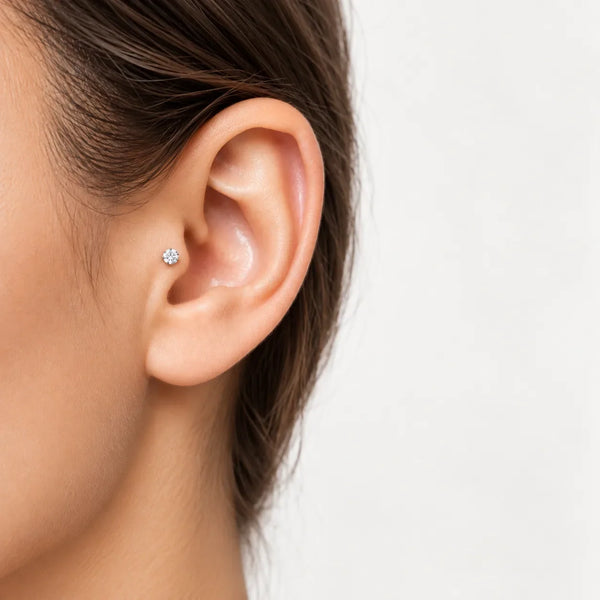
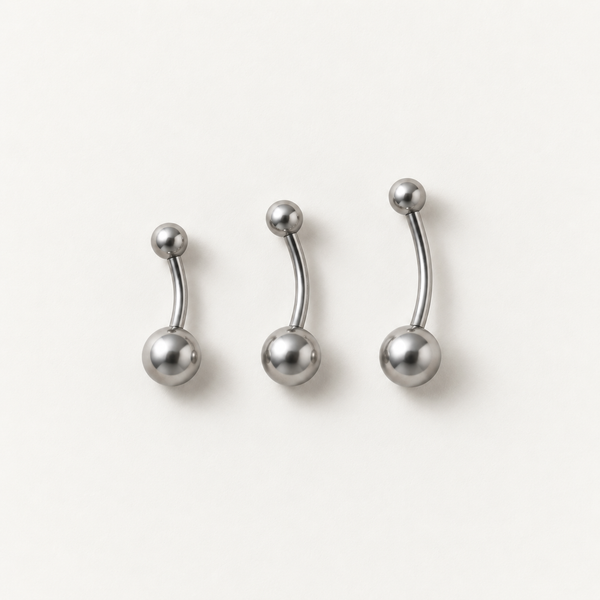
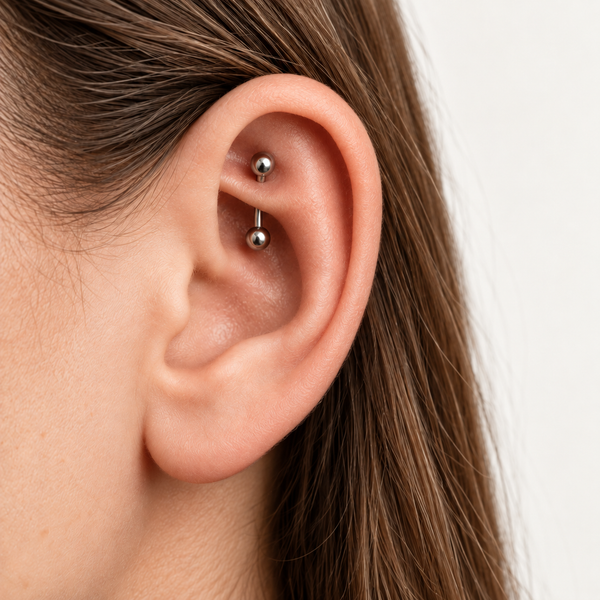
Quick Answer: Sleep off the pierced side — and for an ear piercing, a travel pillow with the ear in the hole lets side-sleepers keep their habit without pressure on the piercing. Wear a flat-back labret rather than a butterfly-back earring, since the smooth flat disc has nothing to dig into your neck. Change or flip your pillowcase every 2 to 3 nights while healing. Expect to sleep carefully for the first 4 to 8 weeks; the piercing itself takes longer to heal fully — 6 to 8 weeks for lobes and 6 to 12 months for cartilage — but the acute "do not touch" tenderness fades much sooner. Jewellery stays in at night, always.
Informational only, not medical advice. If a piercing is hot, swollen, weeping or increasingly painful, see your piercer or GP.
A third of a piercing's early life happens while you are asleep, and it is the only part you cannot supervise. Most of the irritation piercers see — the morning soreness, the crooked helix, the stubborn bump — traces back to eight unconscious hours of pressure on a healing wound, not to anything done while awake.
The fix is mostly setup: the right jewellery, the right pillow arrangement, and a clean surface under your face. This guide covers ears in detail, then the easier cases of nose and navel, and what to do the morning after you wake up on the wrong side.
How do you sleep with a new ear piercing?
On the other side, with a flat-back labret in the piercing — and if you cannot stay off that side, a travel pillow turned so your ear sits in the hole. Those three things remove almost all of the pressure problem.
Side-sleeping on a fresh piercing presses the jewellery into the channel all night. The piercing responds the way any healing wound responds to constant pressure: swelling, soreness, and over weeks, the irritation bumps and slight angle changes that are hard to undo. One bad night does little; the same bad night repeated for a month does a lot.
New piercings on both sides at once make this harder, which is why piercers often suggest doing one ear per visit if you sleep on your side. If both are already done, back-sleeping and the travel pillow carry you through.
| Piercing | Careful-sleep window | Full healing |
|---|---|---|
| Earlobe | 4 to 8 weeks | 6 to 8 weeks |
| Helix, flat, forward helix | 3 to 6 months | 6 to 12 months |
| Tragus, conch, rook, daith | 3 to 6 months | 6 to 12 months |
| Nostril and septum | 4 to 8 weeks, face-down sleepers longer | 2 to 4 months |
| Lip and philtrum | 4 to 6 weeks | 2 to 3 months |
| Navel | 4 to 6 weeks off the stomach | 6 to 12 months |
The careful-sleep window is shorter than full healing everywhere: it covers the acutely tender phase, after which occasional pressure stops being a setback even though the channel is still finishing underneath.
Why does sleeping on a piercing cause problems?
Constant pressure irritates the channel, shifts the jewellery's angle, and grinds the back of the earring into your skin — three separate problems from one habit. Snagging on bedding adds a fourth.
Pressure is the main one: a healing channel under eight hours of load stays inflamed, and chronic inflammation is where irritation bumps come from. Angle shift is the sneaky one — months of sleeping on a helix stud can leave it sitting at a visibly different angle than it was pierced at. And hardware matters: a butterfly back has edges, gaps and a post tip that press patterns into your neck, where a flat disc just lies there.
Snags are the acute version. Loose weaves, hair, and the seam of a pillowcase can hook a ring or a dangling charm mid-turn. This is one of several reasons rings come after healing, not during it.
Which jewellery is best to sleep in?
A flat-back labret with a small, low top — the design exists for exactly this. The comparison is stark enough to table.
| Jewellery | Sleeping on it | Why |
|---|---|---|
| Flat-back labret, small top | Best tolerated | Smooth disc behind, nothing protrudes, no gaps to snag |
| Butterfly-back earring | Poor | Post tip and scroll back dig in; backs tighten or loosen overnight |
| Ring or hoop | Poor while healing | Rotates and snags; moves the channel all night |
| Dangling or charm jewellery | Worst | Catches on everything; never for sleeping, never for healing |
This is why piercers fit flat-backs as standard, and why the same piece works from piercing day to years later. A plain example like the Star Labret in Silver at £10 keeps the profile low on the pillow side and the back smooth against the neck.
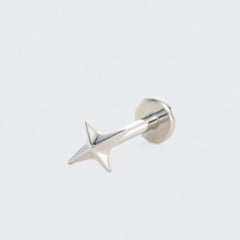
Titanium earns its keep overnight too: at roughly half the weight of steel, the jewellery pulls on the channel less however you lie, and nickel-free metal means eight hours of skin contact without reaction.
What is the travel pillow trick — and what else works?
Turn a U-shaped travel pillow sideways so your pierced ear hovers in the opening — you sleep on your preferred side with no pressure on the piercing. It is the single most recommended piece of kit for new ear piercings.
| Setup | How it works | Best for |
|---|---|---|
| Travel pillow, ear in the hole | Side-sleeping with zero ear pressure | Committed side-sleepers |
| Donut or CNH pillow | Purpose-made hole in a normal pillow shape | Cartilage piercings, longer healing |
| Extra pillow behind the back | Props you against rolling over | Training yourself to back-sleep |
| Satin or silk pillowcase | Less friction if you do land on it | Everyone; also kinder to hair |
| Clean t-shirt over the pillow | Fresh surface nightly without laundry | The hygiene section below |
The back-sleeping ambition is worth a try but fails most people by 3am; the travel pillow succeeds because it works with your habit instead of against it. Buy the cheap airport kind — it is going to spend two months under your ear, not around your neck.
For what it is worth, people with multiple cartilage piercings often keep the travel pillow permanently. Even healed cartilage can ache after a heavy night directly on it.
How do you sleep with a new nose piercing?
Mostly as normal — a nostril or septum piercing only takes pressure if you sleep face-down, so side and back sleepers need nothing special beyond a clean pillowcase. The nose is the easy case.
Face-down sleepers have the one real problem, and the fix is the same travel pillow, turned so the face hovers rather than presses. A nostril stud ground into a pillow all night irritates the channel exactly like an ear, and a healing nostril is quick to bump and slow to forgive.
The other nose-specific risk is the snag-and-lost-stud: a nose screw or L-shape worked loose by friction can leave the bed before you notice, and a healing nostril shrinks within hours of being empty. A correctly seated screw resists this well; checking it is seated each night costs nothing. If the stud is gone in the morning and the hole resists the spare, that is a piercer visit, not a push.
How do you sleep with a new navel piercing?
Back and side sleeping are both fine; stomach sleepers need the first 4 to 6 weeks on their back or side, and everyone benefits from loose nightwear. The navel's enemies are waistbands and friction, not pillows.
High-waisted pyjama bottoms that sit exactly on the piercing are the classic mistake — move the waistband above or below the navel, or sleep in a loose t-shirt and nothing tight. The piercing should not spend the night under elastic.
Stomach sleeping presses a fresh navel bar into the mattress with your whole torso's weight. Most people adapt with a pillow under the hip to encourage a side position; by 6 weeks the acute tenderness has usually faded enough that an accidental night face-down is uncomfortable rather than damaging. The full healing timeline is long — 6 to 12 months — but the sleep-critical window is those first weeks.
How often should I change my pillowcase?
Every 2 to 3 nights while a face or ear piercing heals — or flip it after one night and change it after two, or drape a clean t-shirt over the pillow each night. Your pillowcase collects skin oils, hair product and bacteria, and a healing piercing lies in it for hours.
The clean t-shirt trick is the APP's own suggestion and the laziest compliant option: a fresh, large t-shirt stretched over the pillow, flipped to the clean side on night two, swapped for a new one on night three. Four t-shirts cover a week with one wash load.
This is cheap insurance rather than paranoia. Piercers see the pattern — the piercing on the sleeping side of someone who changes bedding monthly flares more — and the pillowcase is the easiest variable in the whole routine to control. Hair product residue counts too: hairspray and dry shampoo transferred to the pillowcase ends up in the piercing by morning.
I slept on it — how do I fix a sore piercing in the morning?
One rough night needs nothing but your normal saline routine; a piercing that is sore every morning needs the setup changed, not more cleaning. Morning soreness is feedback, not failure.
After a bad night: clean as usual with sterile saline, leave the jewellery alone, and let the throb settle over the day — it almost always does. Do not add extra products, do not twist the jewellery to "check it", and do not switch to harsher cleaning; over-cleaning irritates a piercing as reliably as sleeping on it.
Recurring morning soreness means the pressure is recurring: revisit the travel pillow, the jewellery choice, and which side you actually wake up on. If soreness comes with increasing redness, heat, swelling or weeping — or a bump that grows week on week — stop troubleshooting and see your piercer or GP.
Common sleeping-with-piercings mistakes
Taking the jewellery out at night. A healing piercing can tighten in hours; morning reinsertion into a shrunken channel is how piercings get damaged. Jewellery stays in around the clock.
Sleeping in butterfly-back earrings. The backs dig in, trap hair, and tighten against the lobe overnight. A flat-back labret fixes all three.
Wearing rings or dangly pieces to bed while healing. They rotate, snag and catch. Studs at night until fully healed.
Hair down over a fresh ear piercing. Hair wraps around jewellery at night and pulls. A loose braid or bun keeps it clear.
The month-old pillowcase. Oils, product and bacteria against a healing wound for eight hours. Two to three nights, then change or flip.
Powering through on the pierced side. Discomfort you can ignore at 11pm is still pressure at 4am. The travel pillow exists; use it.
How Oxies does it
Sleep-friendly is most of what a flat-back labret is for, and ours are built for round-the-clock wear: ASTM F136 implant-grade titanium, so there is no nickel against your skin through the night, light enough not to drag on the channel, with a smooth fixed disc at the back and low-profile tops from 2.5mm up. Gold, rose gold and black are PVD finishes bonded into the metal. Every order is sterilised and sealed before posting. Labrets start at £10, UK delivery is free over £25, and two pieces save 25% while three or more save 40%. Browse flat-back labrets.
Frequently asked questions
Can I take my earring out at night to sleep?
No — a healing piercing can shrink within hours, and you may not get the jewellery back in by morning. Healed piercings can sometimes manage a night empty, but there is no need to find out: comfortable flat-back jewellery makes removal pointless. If it is uncomfortable enough to tempt you, the jewellery is wrong, not the rule.
How long until I can sleep on a new piercing?
Lobes usually tolerate occasional pressure from about 6 to 8 weeks; cartilage wants 3 to 6 months before regular sleeping on it, and some helixes never love it. Let comfort lead inside those ranges: if a night on it leaves the piercing sore next morning, it is telling you it is not ready. Full healing takes longer than the sleep-critical window.
I accidentally slept on my new piercing — have I ruined it?
Almost certainly not — one night causes soreness, not disaster. Clean as normal with saline, leave it alone, and expect the ache to fade through the day. Damage comes from the habit, not the accident; it is weeks of nightly pressure that build bumps and shift angles.
Do silk or satin pillowcases help piercings heal?
They reduce friction and snagging, which helps, but they do not speed healing — and they need washing just as often. Think of them as making the accidents gentler. The bigger wins are the travel pillow and the flat-back jewellery; the fabric is a refinement.
Can I sleep in hoop earrings?
Not while the piercing heals — hoops rotate and snag at night — and even healed, most people find small snug hoops the only comfortable ones to sleep in. A hinged ring with no protruding ends is the best-behaved hoop for healed lobes and cartilage. For anything still healing, flat-back studs at night, whatever you wear by day.
What is the t-shirt trick for piercings?
A clean t-shirt stretched over your pillow as a fresh sleeping surface: flip it the second night, replace it the third. It is the APP's low-effort answer to pillowcase hygiene during healing. Any clean, soft cotton works; the point is that the surface under your piercing is days old, not weeks.
Why does my piercing hurt more in the morning?
Usually because you slept on it, or because overnight swelling pools while you lie flat — both settle as the day goes on. Recurring morning pain is the classic sign of unconscious side-sleeping on the piercing, and the travel pillow is the usual fix. Pain that builds over days rather than fading, or comes with heat, spreading redness or discharge, is a piercer-or-GP matter.
When can I go back to sleeping normally?
Once the piercing is fully healed — 6 to 8 weeks for lobes, 6 to 12 months for cartilage and navels — you can sleep however you like, though cartilage may always prefer the odd night off. Healed piercings in smooth flat-back jewellery are effectively sleep-proof. If normal sleeping keeps flaring a supposedly healed piercing, it needed more time than it got.
Key takeaways
- Sleep off the pierced side for the first 4 to 8 weeks; a travel pillow with the ear in the hole lets side-sleepers cheat safely.
- Flat-back labrets are the sleeping jewellery: smooth disc, no gaps, nothing to dig in. Butterfly backs, rings and danglies wait for daytime or healing.
- Jewellery stays in at night — a healing hole can tighten in hours, and nothing gets forced back through in the morning.
- Pillowcase every 2 to 3 nights, or the clean t-shirt trick: fresh surface, flipped nightly.
- Nose piercings only need care from face-down sleepers; navels need loose waistbands and 4 to 6 weeks off stomach-sleeping.
- One accidental night on it means saline and patience, not panic. Every morning sore means change the setup.
- Hair up, bedding clean, titanium in: the whole routine in six words.
- Increasing heat, swelling, weeping or a growing bump is never a sleep problem — piercer or GP.
Make nights the easy part: browse low-profile flat-back labrets from £10, sterilised and posted free in the UK on orders over £25.