Quick Answer: The three barbell shapes match the three ways a piercing can pass through tissue. Straight barbells suit piercings that run in a straight line through flat tissue: tongue, nipple, industrial, bridge and many helix and conch piercings, usually at 14g or 16g and 6mm to 38mm long. Curved barbells (banana bars) suit piercings through curved or folded tissue where a straight bar would stick out: eyebrow, rook, snug, navel and vertical lip, mostly 16g at 6mm to 10mm or 14g at 10mm for the navel. Circular barbells (horseshoes) are open rings for septum, daith, helix, lip and nipple piercings, usually 16g at 8mm to 10mm inner diameter. If your current jewellery sits flat and comfortable, buy the same shape again.
Informational only, not medical advice. If a piercing is hot, swollen, weeping or increasingly painful, see your piercer or GP.
"Barbell" covers three different shapes, and shops rarely explain which is which. Buy a straight bar for a rook and it will jut out of your ear at an angle. Buy a curved bar for a tongue and the balls will sit against your teeth. The shape is not a style choice, it is a fit choice, and the wrong one is uncomfortable within a day.
This guide explains what each shape is for, lists the piercings that use it, gives the standard size for every placement, and covers the questions people ask most: can you swap one shape for another, what size do you need, and which is right for a fresh piercing.
What is the difference between straight, curved and circular barbells?
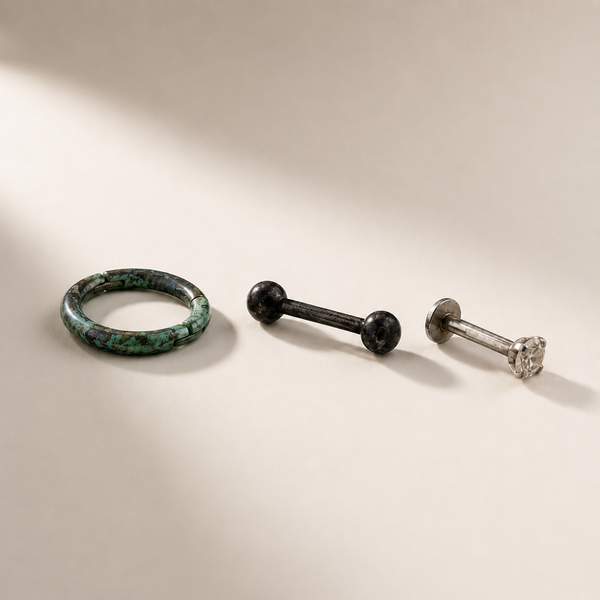
A straight barbell is a straight bar with a ball or end on each side. A curved barbell is the same bar bent into a gentle arc. A circular barbell is bent into almost a full circle, leaving a gap between the two balls. All three are threaded or push-fit at one end so a ball can come off for insertion.
The shape decides how the jewellery sits in the tissue. A piercing through a flat area, like the tongue, goes straight in and straight out, so the bar should be straight. A piercing through a fold or ridge, like the eyebrow, enters and exits at an angle, so the bar needs to curve to follow it. A circular barbell is a ring that can be opened by unscrewing a ball, which makes it the easiest hoop to put in yourself.
| Straight barbell | Curved barbell | Circular barbell | |
|---|---|---|---|
| Also called | Straight bar, industrial bar (long version) | Banana bar, bent barbell, belly bar (14g navel version) | Horseshoe, horseshoe ring |
| Shape | Straight | Gentle arc, roughly a quarter circle | Near-full circle with a gap |
| Measured by | Bar length between the balls | Bar length between the balls, following the curve | Inner diameter across the inside of the ring |
| Common gauges | 14g (1.6mm), 16g (1.2mm) | 14g navel, 16g everything else | 16g most, 14g septum and nipple |
| Common sizes | 6mm to 38mm | 6mm to 12mm | 6mm to 12mm |
| Best for | Tongue, nipple, industrial, bridge, healed helix and conch | Eyebrow, rook, snug, navel, vertical labret, daith (fresh) | Septum, daith, helix, lip, nipple, lobe |
Which piercings use a straight barbell?
Straight barbells are for piercings that pass in a straight line through a flat piece of tissue: tongue, nipple, industrial, bridge, and healed cartilage piercings such as helix, conch and tragus. The bar should be just long enough to clear the tissue on both sides with a little room to move.
The tongue is the classic straight barbell piercing. It is pierced vertically through the centre of the tongue at 14g, fitted long at around 19mm to allow for swelling, then downsized to 14mm to 16mm once healed. Nipples are pierced horizontally at 14g and take a 12mm to 16mm straight bar. The industrial is two helix piercings joined by a single long straight bar, almost always 14g and 32mm to 38mm.
Straight barbells are also a common choice for healed helix, forward helix, conch and tragus piercings when the wearer wants a bar with a ball on both sides rather than a flat disc at the back. A 16g 6mm to 8mm straight barbell does the job. A bridge piercing, across the top of the nose between the eyes, uses a 14g straight bar of 12mm to 16mm.
The Straight Barbell with Balls in Silver is a plain 16g titanium bar in 6mm to 14mm lengths, which covers healed cartilage piercings from tragus to conch.

For industrials, the CZ Paved Pole Industrial Barbell in Silver comes in 14g at 36mm or 38mm, which fits the large majority of adult ears.

Which piercings use a curved barbell?
Curved barbells are for piercings through curved, folded or ridged tissue where the entry and exit holes are not in a straight line: eyebrow, rook, snug, navel, vertical labret, anti-tragus and many fresh daith piercings. The curve lets the bar follow the tissue so both ends sit flat against the skin.
The eyebrow is pierced vertically through the ridge of the brow at 16g and wears an 8mm curved bar, sometimes 10mm while healing. The rook is a fold of cartilage inside the upper ear and takes a 16g curved bar of 6mm to 8mm. The snug, on the inner ridge of the ear, uses a 16g 8mm curve. A vertical labret goes through the lip from the top edge to just below, and wears a 16g 8mm to 10mm curved bar so that both balls sit on the outside of the lip.
The navel is the one place where a curved barbell is thicker and longer: 14g at 10mm as standard, with the bottom ball usually larger or decorated. That is what "belly bar" means. A daith is often pierced with a curved barbell because it heals more predictably than a ring, then switched to a ring later.
The Oval Cut Prong Set CZ Belly Bar in Silver is the standard 14g 10mm navel spec in titanium.

Which piercings use a circular barbell?
Circular barbells, or horseshoes, are open rings that work in almost any piercing that takes a hoop: septum, daith, helix, lip, nipple, lobe and healed nostril. They are the easiest ring to fit yourself because one ball unscrews and the ring slides straight in.
The septum is the most common circular barbell piercing. A 16g horseshoe at 8mm or 10mm inner diameter sits in the sweet spot of the septum and can be flipped up inside the nose to hide it, which a closed ring cannot do. The daith takes a 16g 8mm to 10mm horseshoe once healed. Helix and lobe piercings take 16g at 8mm to 10mm, and a lip piercing usually 16g at 8mm to 10mm as well.
Nipples take a 14g horseshoe at 12mm to 14mm, though a straight bar heals better and is what most piercers fit first. A horseshoe is also a good stepping stone to a closed ring: it is easier to insert than a seamless ring and cheaper than a hinged clicker, and the open gap means you can size it by eye.
The Circular Barbell with Balls Horseshoe in Silver is a plain 16g titanium horseshoe in 6mm, 8mm, 10mm and 12mm, which covers septum, daith, helix and lobe.

For a comparison of horseshoes against segment rings and clickers, see our upcoming guide Segment Rings vs Clicker Rings vs Seamless Rings: Which Should You Buy?
Curved barbell vs straight barbell: which does my piercing need?
Look at the jewellery your piercer fitted. If it was straight, buy straight. If it was curved, buy curved. If you cannot remember, use the table below, which reflects what UK piercers fit as standard. The shape follows the anatomy, and the anatomy has not changed.
| Piercing | Standard shape | Alternative once healed | Why |
|---|---|---|---|
| Tongue | Straight | None | Passes vertically through flat tissue |
| Nipple | Straight | Circular barbell | Horizontal, flat |
| Industrial | Straight (long) | None | Joins two holes in a line |
| Bridge | Straight | None | Horizontal across the nose |
| Helix | Labret or straight | Circular or segment ring | Flat rim of cartilage |
| Forward helix | Labret or straight | Small ring | Small, flat |
| Tragus | Labret or straight | Ring | Flat nub of cartilage |
| Conch | Labret or straight | Ring (outer conch) | Flat bowl of cartilage |
| Anti-tragus | Curved | Ring | Ridge of cartilage |
| Rook | Curved | Ring | Fold of cartilage |
| Snug | Curved | None usually | Inner ridge, angled |
| Daith | Curved (fresh) | Circular or segment ring | Fold of cartilage |
| Eyebrow | Curved | None | Passes through a ridge |
| Vertical labret | Curved | None | Follows the curve of the lip |
| Navel | Curved (14g belly bar) | Hinged belly clicker | Passes through the fold above the navel |
| Septum | Circular barbell or ring | Segment ring, clicker | Sweet spot of the septum |
| Lip (side) | Labret | Circular or segment ring | Flat |
| Lobe | Labret or straight | Any ring | Flat |
For gauge and length by piercing, see our Body Jewellery Size Chart.
What size barbell do I need?
Straight and curved barbells are sized by the length of the bar between the two balls. Circular barbells are sized by inner diameter. Gauge is the bar thickness, and for barbells it is almost always 14g (1.6mm) or 16g (1.2mm). Get those two numbers right and the piece will fit.
Length is the one people get wrong. A fresh piercing is fitted long, to allow for swelling. Once healed, usually after four to eight weeks for soft tissue and longer for cartilage, the bar is downsized. If your bar sticks out well past the skin on one side, it is the fresh-piercing length and it is time to size down.
| Piercing | Gauge | Fresh length or diameter | Healed length or diameter |
|---|---|---|---|
| Tongue | 14g | 19mm straight | 14mm to 16mm straight |
| Nipple | 14g | 14mm to 16mm straight | 12mm to 14mm straight |
| Industrial | 14g | 38mm straight | 32mm to 38mm straight |
| Bridge | 14g | 14mm to 16mm straight | 12mm to 14mm straight |
| Helix, tragus, conch | 16g | 8mm straight | 6mm straight |
| Eyebrow | 16g | 10mm curved | 8mm curved |
| Rook | 16g | 8mm curved | 6mm curved |
| Snug | 16g | 10mm curved | 8mm curved |
| Vertical labret | 16g | 10mm curved | 8mm curved |
| Navel | 14g | 10mm to 12mm curved | 10mm curved |
| Septum | 16g | 8mm to 10mm circular | 8mm to 10mm circular |
| Daith | 16g | 8mm curved | 8mm to 10mm circular |
| Lip (ring) | 16g | 10mm circular | 8mm to 10mm circular |
To measure a barbell you already own, lay it flat and measure the bar from the inside of one ball to the inside of the other. For a curved bar, follow the curve. For a horseshoe, measure across the inside of the ring at its widest point.
Can I put a curved barbell in a straight piercing, or a straight one in a curved piercing?
Usually not comfortably. A curved bar in a straight piercing will try to twist the channel; a straight bar in a curved piercing will stick out at an angle and put pressure on one edge of each hole. For healed piercings a small mismatch is tolerable for a short time. For healing piercings it is one of the quickest ways to cause an irritation bump.
There are a few exceptions. A slight curve, such as a 16g 8mm curved barbell, will sit acceptably in some helix and conch piercings where the cartilage has a gentle curve of its own. A daith pierced with a curved bar is expected to move to a ring later. And a circular barbell can replace a straight bar in a healed nipple.
What you should never do is force a bar that clearly does not follow the channel. If it takes effort to get the second ball on, the shape is wrong.
Which barbell is best for a new piercing?
Whatever your piercer fitted. For a fresh piercing the shape is chosen for healing, not for looks: straight for tongue, nipple and industrial; curved for eyebrow, rook, snug, navel and often daith; and a labret stud rather than a barbell for most ear cartilage. Rings of any kind, including circular barbells, are generally left until the piercing has healed.
The reason is movement. A ring rotates through the healing channel every time you touch it, sleep on it or catch it on a towel, dragging bacteria and crust through the wound. A bar stays put. That is why the APP and most UK piercers recommend a bar or stud for the initial jewellery in almost every placement, and why a horseshoe in a fresh septum is one of the few exceptions, because the septum is soft tissue that tolerates it.
Once healed, the choice opens up. A healed daith can wear a horseshoe, a healed helix can take a small ring, and a healed nipple can move from a straight bar to a circular one.
How do I open a barbell?
Hold the fixed ball in one hand and turn the other ball anticlockwise to loosen it. To close, screw it back on clockwise until it stops, then check it does not turn further with a light pull. Most barbells have one fixed end and one removable ball; curved and circular barbells sometimes have both balls removable.
Dry hands slip on small balls. A pair of clean latex or nitrile gloves gives you far more grip, and a folded tissue does the same in a pinch. Do the final tightening with the jewellery in place, not before, so you are not trying to thread a ball through a piercing. Check the ball is tight once a week; a loose ball is the most common way a barbell is lost.
For a full walkthrough of changing each jewellery type, including hinged rings, see our upcoming guide How to Change Your Piercing Jewellery at Home.
Common barbell mistakes
Buying a straight barbell for a rook or eyebrow. The most frequent mismatch. Both piercings pass through a ridge and need a curve.
Measuring the bar including the balls. Barbell length is the bar only. Including the balls adds 4mm to 8mm and gives you a piece far too short.
Confusing length and inner diameter. A 10mm straight bar and a 10mm horseshoe are not the same size in any useful sense. One is a bar 10mm long; the other is a ring with a 10mm gap inside it.
Wearing the fresh length after healing. A 19mm tongue bar or a 10mm eyebrow bar is a healing size. Once the swelling has gone the extra length catches, moves and lets the piercing drift.
Putting a horseshoe in a fresh cartilage piercing. Rings rotate and drag through a healing channel. Use a bar or labret first, and switch to a horseshoe once healed.
Not checking the balls. A barbell only stays in because the ball is tight. Check it weekly.
How Oxies does it
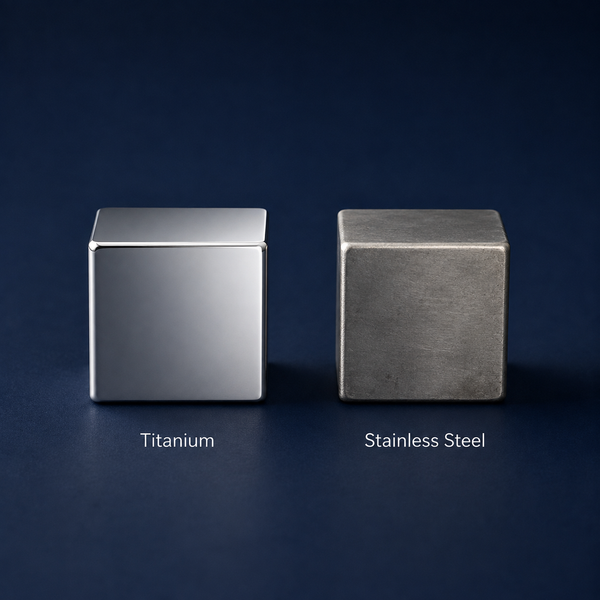
Every barbell we sell is ASTM F136 implant-grade titanium, so it is nickel-free and safe for healing and healed piercings. Straight barbells are 16g in 6mm to 14mm lengths from £7.99. Circular barbells are 16g in 6mm to 12mm inner diameters from £9.99. Industrials are 14g at 35mm to 38mm from £10.99, and belly bars are 14g at 10mm from £13.99. Every piece is sterilised before it is posted. UK delivery is free over £25, and if you need more than one piece, two save 25% and three or more save 40%. Browse the barbell range.
Frequently asked questions
What is a curved barbell used for?
Curved barbells are used in piercings that pass through a fold or ridge of tissue, so the two ends need to sit at an angle to each other. The common ones are eyebrow, rook, snug, vertical labret, anti-tragus and navel. Fresh daith piercings are often fitted with a curved barbell too.
Is a banana bar the same as a curved barbell?
Yes. Banana bar, bent barbell and curved barbell all mean the same thing. "Belly bar" is the 14g, 10mm version worn in the navel, usually with a larger or decorated bottom ball.
Can you wear a circular barbell in a helix?
Yes, once the helix has healed. A 16g horseshoe at 8mm or 10mm inner diameter is a standard healed helix ring. For a fresh helix, use a labret stud or a short straight barbell and switch to the horseshoe after healing, which for cartilage is usually six to twelve months.
What size circular barbell for a septum?
Most septums take a 16g circular barbell at 8mm or 10mm inner diameter. Use 8mm for a snug fit that sits close to the tip of the nose, and 10mm if your piercing sits higher or you want a more visible hoop. Some septums are pierced at 14g; check with your piercer if unsure.
What length straight barbell for a tongue?
A healed tongue takes a 14g straight barbell of 14mm to 16mm. The initial bar is around 19mm to allow for swelling and should be downsized after two to four weeks once the swelling has gone. Wearing the long bar after healing is the main cause of chipped teeth and gum wear.
How long should an industrial barbell be?
Most industrial barbells are 32mm to 38mm, with 38mm the most common adult size. The correct length is the distance between your two piercings plus 2mm to 4mm of clearance. Measure your current bar before buying, as ears vary.
Can I put a straight barbell in my eyebrow?
Not comfortably. The eyebrow passes through a ridge, so a straight bar will stick out at an angle and press on the edge of each hole. Use a 16g curved barbell at 8mm, or 10mm if the piercing is still healing.
Are barbells better than rings for new piercings?
Yes, for almost every placement. A bar stays still in the healing channel while a ring rotates and drags through it. UK piercers fit a bar or labret stud for initial jewellery in the tongue, nipple, eyebrow, rook, navel and all ear cartilage, and only fit rings in fresh septum and some lip piercings.
Key takeaways
- Straight barbells suit piercings that pass in a straight line through flat tissue: tongue, nipple, industrial, bridge, healed cartilage.
- Curved barbells suit piercings through a fold or ridge: eyebrow, rook, snug, vertical labret, navel, fresh daith.
- Circular barbells are open rings for healed septum, daith, helix, lip and nipple piercings, and the easiest hoop to fit yourself.
- Straight and curved bars are sized by bar length between the balls. Circular barbells are sized by inner diameter.
- 16g (1.2mm) covers most ear, face and lip barbells; 14g (1.6mm) is standard for tongue, nipple, industrial, bridge and navel.
- Fresh piercings are fitted long. Downsize after healing or the bar will catch and the piercing can drift.
- Do not swap shapes. A curved bar in a straight channel or a straight bar in a curved one causes irritation.
- Bars and studs for new piercings, rings once healed. Check the balls are tight once a week.
Ready to find the right shape? Browse implant-grade titanium barbells from £7.99, with free UK delivery over £25.