Quick Answer: You can change your own jewellery once the piercing is fully healed: roughly 6 to 8 weeks for lobes, 2 to 3 months for septum and lip, and 6 to 12 months for cartilage such as helix, tragus, conch and daith. Wash your hands, work over a towel with a mirror and good light, and have the new piece cleaned and ready. Hinged segment rings open by pulling the small segment away from the hinge, not by twisting. Labrets unscrew from the front, with the flat disc staying behind the piercing. Barbells and horseshoes open by unscrewing one ball anticlockwise. Never force anything: if it hurts, bleeds more than a spot, or will not go through, stop and see a piercer.
Informational only, not medical advice. If a piercing is hot, swollen, weeping or increasingly painful, see your piercer or GP.
The first change is the hardest, and most of that is nerves rather than difficulty. Once you know how each closure works, changing a segment ring or a labret takes under a minute. The mistakes that cause problems are almost always the same three: changing too early, twisting a hinged ring sideways, and forcing a post through a hole that has tightened.
This guide covers when it is safe, what to have ready, a step-by-step for each jewellery type, what to do when the hole seems to have closed, and the situations where a piercer should do it instead.
When is it safe to change my piercing jewellery?
Only when the piercing is fully healed, which is longer than most people think: lobes take 6 to 8 weeks, soft tissue such as septum and lip 2 to 3 months, and cartilage anywhere from 6 to 12 months. The first change and any downsizing during healing should be done by your piercer.
"Healed" means no tenderness, no swelling, no crust, no discharge, and the jewellery moves freely without discomfort. A piercing can look healed on the outside months before the channel inside has fully formed. Changing jewellery before that point tears the new tissue, restarts the healing process and is the most common cause of irritation bumps.
| Piercing | Typical full healing | Earliest sensible home change |
|---|---|---|
| Lobe | 6 to 8 weeks | 8 weeks |
| Lip, labret, Monroe, Medusa | 2 to 3 months | 3 months |
| Septum | 2 to 3 months | 3 months |
| Nostril | 4 to 6 months | 6 months |
| Eyebrow | 2 to 3 months | 3 months |
| Tongue | 4 to 8 weeks | 8 weeks (downsize by a piercer at 2 to 4 weeks) |
| Navel | 6 to 12 months | 9 months |
| Nipple | 6 to 12 months | 9 months |
| Helix, forward helix | 6 to 12 months | 9 months |
| Tragus, anti-tragus | 6 to 12 months | 9 months |
| Conch | 6 to 12 months | 9 months |
| Daith, rook, snug | 6 to 12 months | 12 months |
| Industrial | 9 to 12 months | 12 months |
If the piercing is in the healing window and the jewellery is too long or has a problem, book the piercer. A downsize at the right time is a five-minute job for them and a real risk for you.
What do I need to change piercing jewellery?
Clean hands, the new jewellery already cleaned, a mirror, good light, a towel over the sink, and ideally a pair of clean nitrile or latex gloves for grip. Nothing else is essential. A few extras make it easier.
Every piece from Oxies is sterilised before it is posted, but once the packet is open it has been handled, so rinse it in warm water with a drop of mild soap and dry it before it goes in. Never use alcohol or bleach on jewellery going into a piercing.
| Item | Why | Essential? |
|---|---|---|
| Washed hands or clean gloves | Bacteria into a piercing channel is how infections start | Yes |
| The new piece, cleaned and laid out with the closure open | Fumbling with a sealed ring while a piercing is empty is stressful | Yes |
| Mirror and good light | You need to see the back of the piercing, not guess | Yes |
| Towel over the sink or work surface | Small balls bounce and vanish down plugholes | Yes |
| Nitrile or latex gloves | Grip. Titanium balls are small and smooth and slip on dry fingers | Strongly recommended |
| Sterile saline spray | To soften crust before removal and soothe after | Recommended |
| Water-based lubricant or a drop of the saline | Helps a post through a snug hole | Optional |
| Insertion taper (matched to your gauge) | Guides new jewellery through a tight or curved channel | Optional; useful for cartilage rings |
Work sitting down. Standing in front of a bathroom mirror with a hoop in one hand and a ball in the other is how jewellery ends up on the floor.
How do I open a hinged segment ring or clicker?
Hold the ring with the hinge at the top and the small segment at the bottom. Pull the segment straight down and away from the ring, like opening a tiny door. Do not twist it sideways. The segment swings open on its hinge, leaves a gap, and clicks shut again when you press it back.
Hinged segment rings, also called clickers, are the easiest ring to change once you have done it once, and the easiest to damage if you have not. The hinge is designed to move in one plane. Twisting the segment sideways, which is what people do with a seamless ring, bends the hinge pin and the ring will never click cleanly again.
- Wash your hands or put on gloves. Spray the piercing with saline and wait a minute if there is any crust.
- Take the old ring out. If it is a hinged ring, open it as below. If it is a seamless ring, twist the ends apart sideways, never outward, and slide it out.
- Hold the new ring with the hinge between thumb and forefinger. Find the seam where the segment meets the ring. On most rings it is opposite the hinge.
- Press the segment gently outward with a fingernail, or pull it downward, until it pops open. It moves about 30 degrees. It does not come off.
- Feed the open end through the piercing from front to back, following the curve of the ring.
- Once through, rotate the ring so the hinge sits where you want it and press the segment closed. You will feel and usually hear a click.
- Check it is closed by running a finger around the ring. There should be no gap and the segment should not move.
A ring like the White Opal & Clear CZ Side Facing Paved Hinged Segment Hoop Ring in Silver has the stones on the front and the plain segment on the back, so once it is in, rotate it until the stones face forward and the seam is hidden.

If the segment will not open, it is usually because you are pressing on the hinge side. Turn the ring 180 degrees and try the other side of the seam. If it opens but does not click shut, check nothing is trapped in the seam, then press it closed with a little more pressure. If the ring has been bent, it will not close and needs replacing.
For which ring style suits which piercing, see our upcoming guide Segment Rings vs Clicker Rings vs Seamless Rings: Which Should You Buy?
How do I change a labret stud?
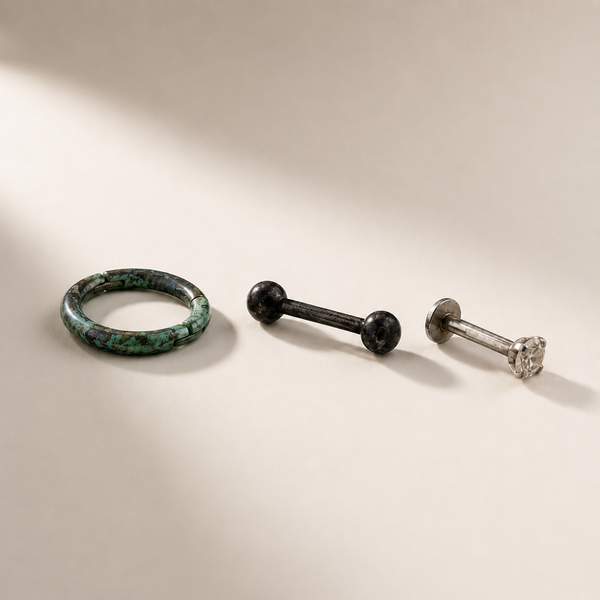
A labret is a post with a flat disc at the back and a removable decorative top at the front. Hold the disc still from behind the piercing and unscrew the top anticlockwise. To insert the new one, push the post in from behind so the disc ends up against the back of the piercing, then screw the top on from the front. The disc is what sits inside your ear or lip, and the top is what shows.
The thing that confuses people is which end goes where. The flat disc goes behind the piercing, on the inside of the ear or the inside of the lip. The post passes through the hole from back to front, and the top screws or pushes onto the end that emerges at the front. If you try to push the disc through the hole, it will not fit and it is not supposed to.
- Wash your hands or put on gloves. Saline the piercing.
- From behind, pinch the flat disc of the old labret between thumb and forefinger so it cannot rotate.
- From the front, turn the decorative top anticlockwise until it comes off. Two or three turns.
- Push the old post out from the front toward the back and set it aside.
- Take the new labret. Unscrew its top and put the top somewhere it cannot roll.
- From behind the piercing, push the post through the hole until it emerges at the front and the disc is flat against the skin at the back. A drop of saline on the post helps.
- Hold the disc still from behind and screw the top on from the front, clockwise, until it stops. Do not overtighten.
- Check by pulling the top gently. It should not turn or come away.
The labrets in our range are 16g with an 8mm post, such as the Bezel Flower Blue Opal Labret in Silver. If the post is longer than your piercing, the top will sit away from the skin and tilt; check the size chart before buying.

Push-fit labrets, where the top has a pin that pushes into the post rather than a thread, work the same way except the top pulls straight out and pushes straight in. If a push-fit top is loose, take it out, bend the pin very slightly, and push it back in.
How do I change a straight or curved barbell?
Unscrew one ball anticlockwise, slide the bar through the piercing, and screw the ball back on clockwise. Curved barbells go in following their curve; do not push a curved bar straight. One ball is usually fixed and the other removable, so if one will not turn, try the other.
- Wash your hands or put on gloves. Saline the piercing.
- Hold the fixed ball of the old barbell still and unscrew the other ball anticlockwise. Put it on the towel.
- Slide the bar out.
- Take the new barbell and remove its loose ball.
- Feed the bar through the piercing from the side that gives the most room to work. For a curved bar, angle it to follow the curve of the channel rather than pushing straight.
- Screw the ball on clockwise until it stops. Do it with the bar in place, so you are not trying to thread a ball through a hole.
- Pull each ball gently to confirm neither turns.
For a straight barbell like the Straight Barbell with Balls in Silver, check the balls once a week. A loose ball is the most common way a barbell is lost.

For which barbell shape suits which piercing, see Straight, Curved & Circular Barbells: Which Piercing Uses Which?
How do I put in a circular barbell or horseshoe?
Unscrew one ball, rotate the open end of the horseshoe through the piercing following its curve, and screw the ball back on. It is the simplest ring to fit because you never have to bend the ring itself.
- Wash your hands or put on gloves. Saline the piercing.
- Unscrew one ball from the new horseshoe. Leave the other ball on; it stops the ring sliding all the way through.
- Feed the open end into the piercing and rotate the ring through the hole, following its curve, until the ring sits in the piercing with both ends outside.
- Screw the ball back on clockwise.
- Rotate the ring until it sits how you want it, with the balls either side of the piercing.
A 16g horseshoe such as the Circular Barbell with Balls Horseshoe in Silver in a septum can be flipped up inside the nose to hide it; rotate it gently by the balls, never by pulling on the ring.

What if the hole seems to have closed?
A healed piercing does not close in hours, but the channel tightens as soon as the jewellery is out. Gentle, steady pressure with a lubricated post at the correct angle almost always finds it. Never push hard, and never use a sharp point. If it will not go through in a few calm minutes, put the old jewellery back in if you can and see a piercer.
A piercing feels closed for three reasons: the surface has crusted over, the tissue has tightened around an empty channel, or you are pushing at the wrong angle. Most piercings are not exactly perpendicular to the skin; the channel runs at the angle the piercer set, which is why feeding jewellery in the direction it came out matters.
| Problem | Likely cause | What to do |
|---|---|---|
| Post stops just inside the hole | Channel tightened, wrong angle, or a thin skin film over the exit | Saline, then tilt the post to match the original angle and apply light steady pressure. Look for the exit dimple at the back. |
| Ring will not follow through | Curve of ring does not match curve of channel | Rotate the ring, do not push. Try a smaller diameter or a taper. |
| Hole feels closed after only a few hours out | Soft tissue swells inward quickly | Saline, gentle pressure with a lubricated post. It is almost never actually closed. |
| Hole closed after days or weeks | Channel has genuinely contracted | An insertion taper of your gauge, or a piercer with one. Do not force. |
| Slight bleeding | Tissue nicked on insertion | Normal for a spot. Saline and leave alone. More than a spot, or ongoing, see a piercer. |
| Sore and swollen the next day | Changed too early, or irritated on insertion | Saline twice a day, leave it alone, do not change again. If it worsens, see a piercer. |
An insertion taper is a smooth, tapered pin that matches your gauge at one end and narrows at the other. You feed the narrow end through, then push the jewellery in behind it. For cartilage rings, daiths and anything you cannot see the back of, a taper turns a fight into a slide. They cost a few pounds and any piercer will sell you one.
When should a piercer change it instead?
The first change, any downsize during healing, anything in the healing window, stretched piercings, and difficult placements you cannot see: daith, rook, snug, inner conch hoops and industrials. A piercer has tapers, receiving tubes and a second pair of hands, and it usually costs less than a coffee.
There is no prize for doing it yourself. A daith ring change in a mirror is difficult even for people who have done it before, because the piercing sits inside a fold you cannot see straight on. Industrial bars pass through two holes and need to be lined up perfectly. If a change has taken more than five minutes, stop, put something back in, and book the studio.
| Do it at home | Go to a piercer |
|---|---|
| Healed lobe, helix, tragus, conch stud, nostril, lip, septum, eyebrow, navel | First change of any new piercing |
| Swapping like for like in a piercing you have changed before | Downsizing during healing |
| Labrets, straight barbells, horseshoes, hinged segment rings | Any piercing still in its healing window |
| Daith, rook, snug and inner conch rings | |
| Industrial barbells | |
| Seamless rings you cannot open, or a bent hinged ring | |
| Stretched piercings | |
| Anything that hurt, bled or would not go through last time |
Common mistakes when changing jewellery
Changing too early. The piercing looks healed on the surface months before the channel is fully formed. Wait for the times in the table above, and let the piercer do the first change.
Twisting a hinged ring sideways. Hinged segment rings open in one plane, like a door. Sideways force bends the hinge pin and the ring never clicks properly again.
Pushing the labret disc through the hole. The flat disc stays at the back. The post goes through from behind and the top screws on at the front.
Forcing a post at the wrong angle. Piercings run at an angle, not straight through. Feed the new piece in the direction the old one came out.
Screwing the ball on before the bar is in. Fit the bar first, then the ball, or you are threading a ball through a piercing.
Leaving the piercing empty overnight. A healed piercing tightens in hours. If the new piece will not go in, put the old one back and try again tomorrow.
Working over an open sink. Titanium balls are small and bounce. Use a towel.
How Oxies does it
Every piece we sell is ASTM F136 implant-grade titanium and is sterilised before it is posted, so it is ready to rinse and wear. Hinged segment rings click shut with no seam to align, labrets are 16g with an 8mm post and a flat disc, and barbells and horseshoes use a simple screw-on ball. Sizes are listed in millimetres on every product so you can match what you are replacing. Pieces start at £9.99, UK delivery is free over £25, and two pieces save 25% while three or more save 40%. Browse the full titanium range.
Frequently asked questions
How do you open a segment ring?
If it is a hinged segment ring, pull the small segment away from the ring on its hinge; it swings open like a door and clicks back shut. If it is a seamless ring with a removable segment, twist the ring sideways to pop the segment out. Never pull a hinged ring's segment sideways, and never pull a seamless ring's ends outward, as both will bend the ring.
Can I change my piercing jewellery myself?
Yes, once the piercing is fully healed and if the placement is one you can see and reach. Lobes, nostrils, lips, septums, eyebrows, navels and most ear cartilage studs are straightforward at home. Daith, rook, snug and inner conch rings, industrials, and any first change are better done by a piercer.
How soon can I change my helix piercing?
Not for 6 to 12 months, and not until it has been free of tenderness, swelling and crust for several weeks. Helix piercings look healed long before they are. If the initial bar is too long, have your piercer downsize it at around 6 to 8 weeks rather than changing it yourself.
Which way does a labret go in?
The post goes in from behind the piercing so the flat disc sits against the back of the ear or the inside of the lip, and the decorative top screws or pushes on at the front. The disc never goes through the hole.
Why won't my hinged ring click shut?
Usually something is in the seam, the segment is not quite aligned, or the hinge has been bent by a sideways twist. Clean the ring, press the segment closed with firm even pressure, and check for a click. If it still will not close flat, the hinge is damaged and the ring needs replacing.
What if my piercing has closed up?
If it has been out for hours, it has almost certainly tightened rather than closed. Saline, a lubricated post, the right angle and gentle steady pressure will usually find the channel. If it has been out for days and will not take a post, an insertion taper or a piercer is the answer. Do not force anything sharp through.
Should I use lubricant to change jewellery?
A drop of sterile saline or a water-based lubricant on the post makes insertion smoother, especially in cartilage. Avoid oils, petroleum jelly and anything scented, which trap bacteria in the channel.
How do I stop the balls falling off my barbell?
Screw them on clockwise until they stop, with the bar already in the piercing, and check them weekly with a gentle pull. Wearing gloves when tightening gives you enough grip to seat the ball properly. If a ball repeatedly loosens, the thread is worn and the piece should be replaced.
Key takeaways
- Change jewellery only when the piercing is fully healed: 6 to 8 weeks for lobes, 2 to 3 months for septum and lip, 6 to 12 months for cartilage.
- Let a piercer do the first change and any downsizing during healing.
- Hinged segment rings open by pulling the segment away on its hinge, never by twisting sideways.
- Labrets go in from behind: disc at the back, post through the hole, top screwed on at the front.
- Barbells and horseshoes open by unscrewing one ball anticlockwise. Fit the bar first, then the ball.
- Feed jewellery in at the angle the old piece came out. Piercings are rarely straight through.
- A piercing that feels closed after hours has tightened, not closed. Saline, lubricant, the right angle and gentle pressure.
- Daith, rook, snug, inner conch rings and industrials are piercer jobs. So is anything that hurt or bled last time.
Ready for your next swap? Browse implant-grade titanium jewellery from £9.99, sterilised and posted free in the UK on orders over £25.