Quick Answer: A nickel reaction at a piercing usually shows as itching, redness, dry or flaky skin, and sometimes small blisters or clear weeping, appearing 12 to 48 hours after the jewellery goes in and improving when it comes out. Nickel is the most common contact allergy in the UK, affecting roughly one in ten adults, and piercings are one of the main ways people develop it. It is in surgical steel (10% to 14%), most plated fashion jewellery, and much white gold. The metals that do not contain it are implant-grade titanium (ASTM F136), niobium, platinum and nickel-free solid gold. If you suspect an allergy, a GP or dermatologist can confirm it with a patch test; in the meantime, switching to titanium is the simplest thing you can do.
Informational only, not medical advice. If a piercing is hot, swollen, weeping or increasingly painful, see your piercer or GP.
Most people who react to earrings assume they have sensitive skin or a mild infection. Often it is neither. It is a specific, common and permanent allergy to one metal, and the reason it keeps happening is that the metal is in almost everything sold as "surgical steel", "hypoallergenic" or "gold plated".
This guide explains what the reaction looks like, how it differs from irritation and infection, where nickel hides, how a doctor confirms the allergy, and what to wear so it stops happening.
What are the symptoms of a nickel allergy from earrings?
Itching is the first and most reliable sign, followed by redness, a dry or flaky rash around the piercing, and in stronger reactions small blisters, cracking or clear weeping. The reaction starts 12 to 48 hours after the jewellery goes in, sits exactly where the metal touches, and eases when the jewellery comes out. It does not usually cause heat, swelling or thick discharge; those point to something else.
Nickel allergy is a type of allergic contact dermatitis. The immune system has learned to recognise nickel ions as a threat, and every time nickel touches the skin it mounts a delayed response. That delay is why the reaction is not instant and why people often fail to connect it to the earrings they put in yesterday.
| Symptom | Nickel reaction | Why |
|---|---|---|
| Itching | Very common, often the first sign | Immune response in the skin |
| Redness | Common, ring-shaped around the hole | Inflammation where the metal touches |
| Dry, flaky or scaly skin | Common, develops over days | Eczema-type reaction |
| Small blisters or bumps | Sometimes, in stronger reactions | Fluid in the inflamed skin |
| Clear or yellowish weeping | Sometimes | Blisters breaking |
| Cracked or thickened skin | With repeated exposure over months | Chronic dermatitis |
| Heat, throbbing, thick discharge | Rare | Suggests infection, not allergy |
| Reaction elsewhere on the body | Sometimes, in people with severe allergy | Spread from the contact site |
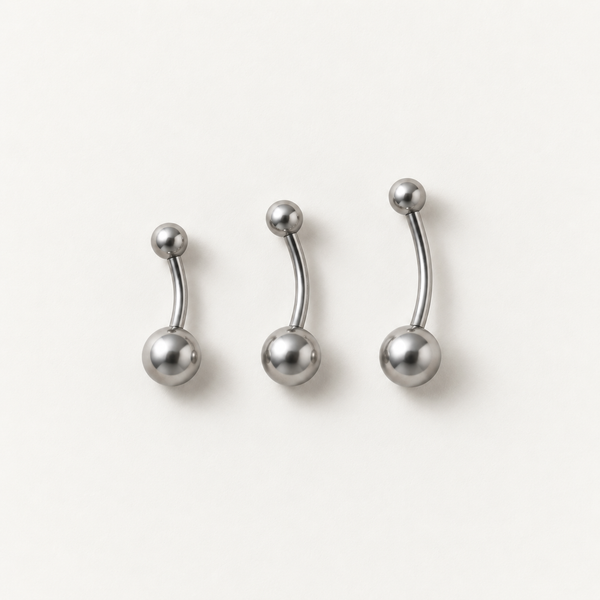
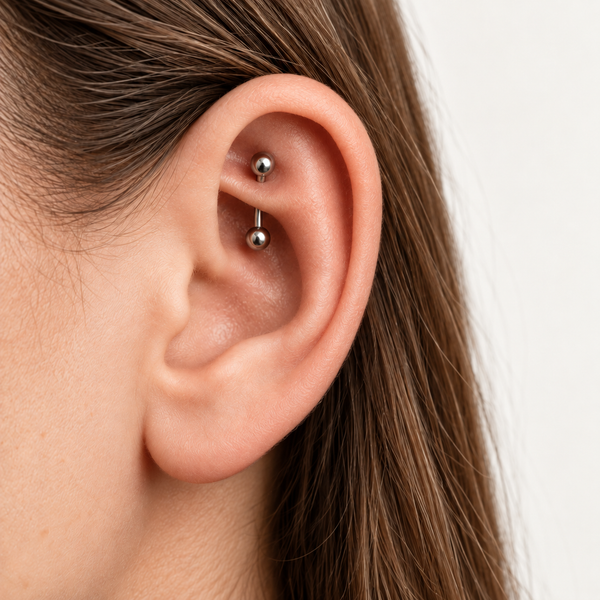
The reaction is worst where contact is closest and longest. On a lobe piercing that is the back of the lobe where the post and butterfly sit. On a cartilage piercing it is around both holes. On a navel it is the crease above the piercing where the top ball rests.
How do I tell a nickel allergy from irritation or infection?
Timing, location and what fixes it. A nickel reaction appears a day or two after new jewellery, sits exactly where the metal touches, itches more than it hurts, and settles when the jewellery is swapped for a nickel-free metal. Irritation follows a knock or a change and settles with rest. Infection is hot, swollen, painful and produces thick discharge, and needs a GP. The three overlap, but the pattern usually gives it away.
| Nickel reaction | Irritation | Infection | |
|---|---|---|---|
| When it starts | 12 to 48 hours after new jewellery | After a snag, sleep pressure, product change or early jewellery change | Days after a break in the skin, any time |
| Main feeling | Itching | Soreness, tenderness | Pain, throbbing, heat |
| Look | Red, dry, flaky, ring-shaped around the hole; sometimes tiny blisters | Red, slightly swollen, possibly a bump | Red, hot, swollen, spreading; thick yellow or green discharge |
| Discharge | Clear weeping at most | Clear lymph, crust | Thick, coloured, often smelly |
| Same jewellery elsewhere | Reacts too | Fine | Not relevant |
| What helps | Nickel-free jewellery | Leaving it alone, saline, correct size | Medical treatment |
| Who to see | GP for confirmation | Piercer | GP, promptly |
Two clues are almost diagnostic. First, the same jewellery causes the same reaction in every piercing you put it in. Second, the reaction stops when you switch to titanium and comes back when you switch to the old piece. If both are true, it is very likely nickel.
The tarnish guide covers a related sign: jewellery that discolours or turns skin green is base metal, and base metal nearly always contains nickel.
How do I know for sure? Getting it confirmed
A GP or dermatologist confirms nickel allergy with a patch test: small amounts of common allergens are taped to the skin, usually on the back, and read after two and four days. It is the only reliable way to be certain. Do not rely on home test kits or on spot-testing jewellery yourself, and do not try to interpret a result you have not been given by a clinician.
The NHS page on contact dermatitis explains the process and when to see a GP. In practice most people do not need the test to decide what to wear: if a piercing reacts to steel and settles in titanium, wearing titanium is the answer whether or not a test is done. The test matters when reactions are severe, when they appear away from the jewellery, or when you need to know for reasons beyond earrings, such as dental work or a job.
Nickel sensitisation is permanent once it develops. There is no cure and no desensitisation; the treatment is avoidance.
Where is nickel hiding in jewellery?
Surgical steel (316L) is 10% to 14% nickel. Most plated fashion jewellery is nickel or a nickel alloy under the plating. Much white gold is nickel-alloyed. "Nickel silver" contains no silver and around 20% nickel. Even sterling silver can be alloyed with small amounts. The words on the packet are not a reliable guide.
| Metal or description | Nickel content | Safe for a nickel allergy |
|---|---|---|
| Implant-grade titanium (ASTM F136) | None | Yes |
| Commercially pure titanium (ASTM F67) | None | Yes |
| Niobium | None | Yes |
| Platinum | None | Yes |
| 14ct to 18ct gold, nickel-free alloy | None, if stated | Yes, if the alloy is stated nickel-free |
| Yellow gold, unspecified alloy | Sometimes small amounts | Usually, but not guaranteed |
| White gold, unspecified | Often 5% to 10% | Often not; palladium white gold is the safe version |
| Rose gold | Rarely | Usually |
| Sterling silver | Usually none; some alloys trace | Usually, but silver tarnishes and is unsuitable for piercings |
| 316L "surgical steel" | 10% to 14% | No for the allergic; low release, not no release |
| Gold-plated steel or brass | Base metal beneath is often nickel-bearing | No once the plating wears |
| "Nickel silver", "German silver", "alpaca" | Around 20% nickel, no silver at all | No |
| "Hypoallergenic" with no material named | Unknown | Assume no |
| "Nickel-free" with no material named | Unregulated claim | Assume no |
UK law limits how much nickel jewellery may release, not whether it contains any. The UK REACH regulation sets a release limit of 0.2 micrograms per square centimetre per week for posts and assemblies inserted into pierced ears and other body parts. Well-made 316L can pass that test and still contain 12% nickel; for someone who is sensitised, that is still enough. And a great deal of imported fashion jewellery has never been tested at all.
Why do piercings cause nickel allergy?
Because a piercing is an open channel through the skin, and the immune system meets nickel ions in a wound rather than on the surface. Ear piercing, especially in childhood with nickel-bearing studs, is one of the leading ways people become sensitised in the first place. Once sensitised, the person reacts to nickel anywhere on the body for life.
Sensitisation needs the immune system to encounter nickel in a way it registers as a threat. Intact skin is a good barrier. A healing piercing is not. Nickel released from a stud sits in the fresh channel for weeks, and that is exactly the exposure that teaches the immune system to react. This is why nickel allergy is markedly more common in people with pierced ears, and why the age at which someone was pierced and what they were pierced with matters.
It is also why the jewellery in a healing piercing should never contain nickel, regardless of whether the person has reacted before. An allergy that has not developed yet can be prevented. One that has cannot be undone.
What should I wear instead?
Implant-grade titanium is the practical answer for almost everyone: it contains no nickel, it is the material used for surgical implants, and it is the standard for initial piercings in UK studios. Niobium, platinum and nickel-free gold are also safe but cost more. For a piercing that has been reacting, titanium is where to start.
| Metal | Nickel | Cost | Notes |
|---|---|---|---|
| Implant-grade titanium (ASTM F136) | None | From about £9 | Light, gold and rose gold by PVD rather than plating, standard for fresh piercings |
| Niobium | None | Similar to titanium | Slightly heavier, also nickel-free; less widely stocked |
| Platinum | None | High | Heavy, expensive, rarely used for body jewellery |
| 14ct+ nickel-free gold | None if specified | High | Ask for the alloy; white gold must be palladium-based |
| Glass | None | Low to moderate | Fine for healed stretched piercings; not for standard jewellery |
The Titanium vs Surgical Steel guide goes through the comparison in detail. The short version is that titanium is what your piercer used, it is what heals best, and it is the one material that removes nickel from the question entirely.
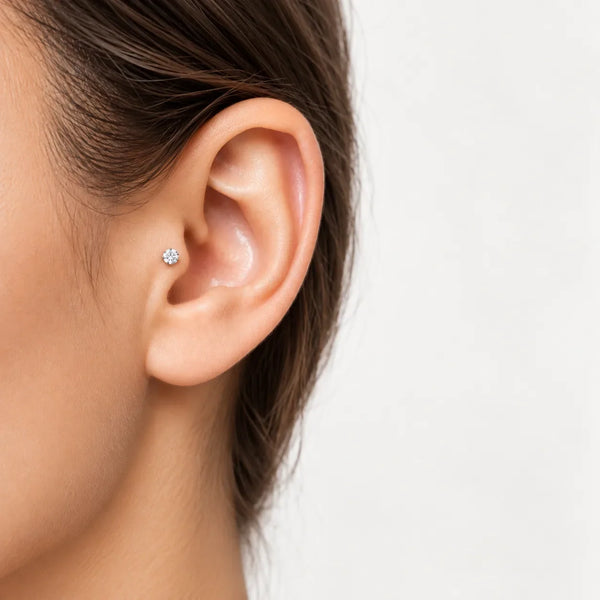
A plain flat-back labret like the Bezel Flower Blue Opal Labret in Silver is a reasonable test: if a piercing that reacted to your old stud settles within a week or two in this, the metal was the cause.

Colour is where nickel-allergic people are usually caught out, because gold-tone and rose-tone jewellery is almost always plated base metal. PVD titanium gets its colour from a finish bonded into the titanium itself, so a rose gold titanium ring like the Clear CZ Side Paved Hinged Segment Hoop Ring in Rose Gold has no plating to wear through and no nickel underneath.

For a plain ring in any size, the Segment Clicker Ring in Gold covers 20g to 14g and 6mm to 16mm, which means a nickel-free option exists for a lobe pierced with a gun as well as a 14g septum.

What to do if a piercing is reacting now
Take the suspect jewellery out if the piercing is healed and replace it straight away with titanium; do not leave the piercing empty. If the piercing is still healing, do not remove the jewellery yourself: see your piercer, who can swap it for titanium without letting the hole close. Clean with sterile saline, leave the area alone, and see a GP if the rash is spreading, blistering badly or not improving within a week or two of the change.
Nickel dermatitis settles on its own once the nickel is gone. It can take days to a couple of weeks for the skin to calm fully, and a piercing that has been reacting for months may take longer. Keep the new titanium jewellery in during that time; a healed piercing tightens quickly when empty, and a healing one can close.
If you have a nickel-free piece in and the reaction has not improved after two to three weeks, something else is going on and it is worth a GP visit. A GP can also prescribe treatment for a bad flare; that is their call, not something to self-manage with over-the-counter creams around an open piercing.
Everyday nickel: beyond jewellery
Once sensitised, people react to nickel wherever it touches skin for long enough: jean buttons and belt buckles on the stomach, watch backs on the wrist, glasses frames on the nose, phone cases, keys held in the hand, and coins. Knowing this helps make sense of rashes that seem unrelated to earrings.
A rash in a neat rectangle below the navel is the classic jean-button reaction. A red patch on the wrist under a watch, or on the nose where metal glasses rest, is the same allergy. None of these is a reason to panic; all of them are a reason to keep nickel away from the skin. Clear nail varnish on a jean button, a plastic-backed watch, and acetate glasses frames are the usual fixes.
For piercings specifically, the fix is simpler: wear a metal with no nickel in it, and check the material before buying rather than trusting the word "hypoallergenic".
Common nickel allergy mistakes
Trusting "hypoallergenic" or "nickel-free" on a packet. Neither term is regulated for jewellery in the UK. Buy by named material and grade.
Assuming surgical steel is safe. It is 10% to 14% nickel. Low release is not no release.
Assuming gold is safe. White gold is often nickel-alloyed. Yellow gold under 14ct often is. Ask for the alloy.
Leaving the piercing empty to "let it calm down". It closes. Swap to titanium instead.
Removing jewellery from a healing piercing yourself. Let the piercer swap it for titanium.
Self-diagnosing from a home kit. A GP patch test is the only reliable confirmation.
Wearing nickel in a child's first piercing. Childhood ear piercing with nickel studs is one of the main causes of lifelong sensitisation. Titanium from the start.
How Oxies does it
Every piece in our range is ASTM F136 implant-grade titanium, which contains no nickel. There is no steel, no plating and no unnamed alloy anywhere in the range, and the gold, rose gold and black finishes are PVD bonded into the titanium rather than plated over something else. Every order is sterilised before it is posted. Pieces start at £9, UK delivery is free over £25, and two pieces save 25% while three or more save 40%. Browse nickel-free titanium jewellery.
Frequently asked questions
What does a nickel allergy look like on ears?
Itchy, red, dry or flaky skin around the piercing hole and on the back of the lobe where the post sits, sometimes with tiny blisters or clear weeping. It appears a day or two after new earrings go in and eases when they come out. Heat, swelling and thick discharge are not typical of nickel and suggest infection.
How long does a nickel allergy rash last?
Days to a couple of weeks after the nickel is removed, longer if the skin has been reacting for months. The rash will not settle while the nickel stays in contact. Swap to a nickel-free metal and leave the area alone; see a GP if it is spreading or not improving.
Is surgical steel OK for a nickel allergy?
Usually not. 316L surgical steel is 10% to 14% nickel. It releases nickel slowly enough to pass UK limits when well made, but a sensitised person can still react to it, and much of what is sold as surgical steel has not been tested. Implant-grade titanium contains none.
Can you develop a nickel allergy later in life?
Yes. Sensitisation can happen at any age, and piercing is one of the most common triggers. People who have worn steel for years without a problem can start reacting after a new piercing exposes them to nickel in a wound. Once it develops, it is permanent.
What earrings are best for a nickel allergy?
Implant-grade titanium (ASTM F136), niobium, platinum, or solid gold in a stated nickel-free alloy. Titanium is the practical choice: it is nickel-free, light, cheap enough to buy several, and available in gold and rose gold finishes without plating.
Is titanium nickel-free?
Yes. ASTM F136 titanium is an alloy of titanium, aluminium and vanadium with no nickel. It is the material used for surgical implants and the standard initial jewellery in UK piercing studios. True allergy to titanium is extremely rare.
Does gold-plated jewellery contain nickel?
Usually, yes, underneath. The plating is gold; the base metal is often brass, nickel or a nickel alloy, and the plating wears through at contact points within weeks to months. Once it does, nickel is against the skin. PVD titanium gives the same gold colour with no nickel underneath.
How do I get tested for nickel allergy?
Through a GP, who may refer you to a dermatologist for a patch test. Small amounts of common allergens are applied to the skin on the back and read after two and four days. It is the only reliable way to confirm the allergy. Home kits are not a substitute.
Key takeaways
- A nickel reaction is itchy, red, dry or flaky, appears 12 to 48 hours after new jewellery, and sits where the metal touches. Heat, swelling and thick discharge point to infection.
- Nickel is the most common contact allergy in the UK, and piercings are one of the main ways people develop it.
- Surgical steel is 10% to 14% nickel. Plated jewellery is usually nickel underneath. White gold often is. "Hypoallergenic" and "nickel-free" are unregulated words.
- Implant-grade titanium, niobium, platinum and stated nickel-free gold contain no nickel.
- A GP or dermatologist confirms the allergy with a patch test. Home kits are not reliable.
- If a healed piercing is reacting, swap to titanium immediately; do not leave it empty. If it is healing, let the piercer do the swap.
- The allergy is permanent. Avoidance is the treatment.
- Titanium from the first piercing prevents sensitisation in the first place.
Reacting to your jewellery? Browse nickel-free implant-grade titanium from £9, sterilised and posted free in the UK on orders over £25.